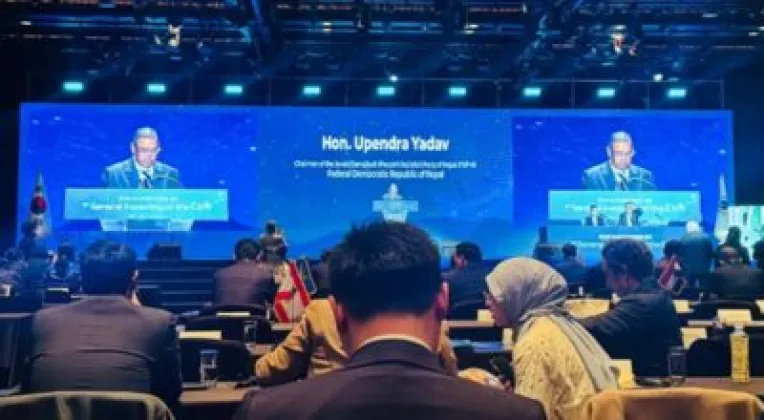
SEOUL, South Korea - Janata Samajwadi Party Nepal Chairman and former Deputy Prime Minister Upendra Yadav has warned that the stability of democracy could be at serious risk if the growing political discontent among young people, and their deepening distrust of traditional political leadership, are not addressed in time. Yadav delivered the caution while addressing the 13th General Assembly of the International Conference of Asian Political Parties (ICAPP) in Seoul, South Korea, on Friday, placing the challenge of youth alienation before senior political figures from across the continent. His speech, covered by Khabarhub, RatoPati and Pradesh Khabar, paired an internal warning about democratic health with a blunt assessment of a troubled global order.
A timely warning from a regional stage
The ICAPP general assembly provides a rare setting in which political parties from across Asia exchange views on the challenges facing their systems of governance. Against that backdrop, Yadav's intervention stood out for its candor. He told delegates that democracies should not assume their own permanence, and that the warning signs of instability are already visible in the mood of a younger generation.
At the heart of his address was a straightforward proposition. Young people, he said, are increasingly disenchanted with politics and with the leaders who have long dominated it. That discontent, combined with a widening trust deficit toward traditional political leadership, is not merely a communications problem for parties. If it is not addressed in time, he cautioned, it can erode the stability of democratic systems themselves.
The framing was notable because it came from within the political class rather than from its critics. Yadav, who has served as Deputy Prime Minister and leads the Janata Samajwadi Party Nepal, effectively directed the message at established parties like those represented in the Seoul hall, arguing that their own standing depends on closing the gap between institutions and the young people they claim to serve.
Democracy beyond the ballot box
Yadav also used the platform to push back against a narrow definition of democracy. Periodic elections, he argued, are necessary but not sufficient. In his telling, democracy means more than the act of voting every few years. He outlined what he presented as its essential pillars:
- Equal rights for all citizens
- Meaningful representation so that people see their concerns reflected in decision-making
- Accountable institutions that answer to the public
Framed this way, his argument was as much about performance as procedure. A democracy that holds votes but fails to deliver fairness, voice and accountability, in his view, gradually loses the loyalty of its citizens, and of the young above all. The formulation links everyday governance to the survival of the democratic system, and it implicitly challenges political parties to look past election cycles when judging their own health.
World politics mired in competition and conflict
Yadav did not confine his remarks to the state of democratic culture. As RatoPati reported, he also described world politics as mired in geopolitical competition and regional conflict.
In a forum built on the premise of Asian cooperation and dialogue, that assessment placed his comments on democracy in a wider frame. Rivalries and conflicts abroad can strain economies, harden political rhetoric and narrow the space in which institutions are expected to deliver for their citizens. By voicing that concern in Seoul, Yadav connected the internal health of democracies to the turbulence of the international environment surrounding them.
A message that travels home
Although the speech was delivered in South Korea and addressed to an international audience, its central concerns travel easily back to Nepal. Yadav chose to speak about trust, representation and accountability rather than party position or personality, a selection of themes that speaks directly to debates now underway within established parties, including his own, about how to remain relevant to younger citizens.
The emphasis on youth is particularly pointed. If, as Yadav warned, younger generations are drifting away from traditional political leadership, the burden falls on parties to demonstrate that democracy delivers more than the ritual of elections. His formula of equal rights, meaningful representation and accountable institutions amounts to a checklist against which governments, including those he has served in, can be measured.
For now, the address stands as one of the more direct messages delivered at the ICAPP gathering: democracies ignore their young at their own peril. Whether the region's political leadership acts on that warning will determine whether Yadav's words are remembered as a timely correction or as a diagnosis that arrived too late.