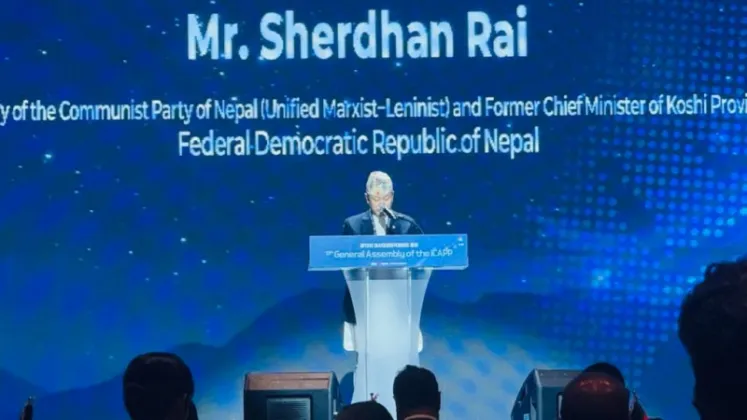
CPN (UML) Secretary Sherdhan Rai has called on the international community to rebuild mutual trust through dialogue and cooperation rather than conflict and confrontation. He delivered the message while addressing the 13th General Assembly of the International Conference of Asian Political Parties (ICAPP) in Seoul, South Korea. The assembly opened on November 4 and continues through November 7, bringing political parties from across the Asian continent to the South Korean capital, where the senior Nepali leader used his platform to argue that peace must anchor relations between nations in a changing world.
A call to rebuild trust in a changing world
Speaking at the gathering, Rai placed the question of trust at the centre of his address, stressing that mutual trust between countries needs to be rebuilt if the world is to manage the changes it is passing through. As reported by Nepal Press, the thrust of his emphasis was captured in a single formulation: rebuild trust in the world through dialogue and cooperation, not conflict.
The choice of language carried weight. Rather than simply appealing for better relations, Rai spoke of rebuilding something that has been strained, presenting the restoration of trust as an active task for the world community. Dialogue, cooperation and peace formed the pillars of that task in his telling. He presented them not as abstract ideals but as practical instruments through which countries with different interests and outlooks can coexist and address shared challenges, and he suggested that a changing world makes these instruments more urgent, not less.
Key points from the address
Rai's message to the assembly can be summarized in three broad appeals:
- Rebuild mutual trust among nations as the world undergoes change, treating trust as the basis for stable relations between countries.
- Prioritize dialogue and cooperation as the preferred tools of diplomacy, particularly where political and cultural differences exist.
- Choose peace over conflict and confrontation, recognizing that the desire for peace is common to all nations regardless of their systems or traditions.
Common ground despite different ideologies and cultures
A second strand of the speech addressed the differences that divide countries. Rai acknowledged that nations vary in political ideology, culture and national background, and he did not suggest those differences could simply be set aside. His argument instead rested on what lies beneath them: a common desire for peace shared by all countries for their peoples.
That shared aspiration, he told the assembly, is reason enough for the world community to engage rather than confront. If every country, whatever its system of government or cultural tradition, wants peace for its people, then dialogue becomes the natural channel through which that common interest can be pursued. On this logic, Rai urged the world community to choose dialogue and cooperation over conflict and confrontation.
The framing was well suited to a forum such as ICAPP, which brings together political parties from across Asia. In Rai's telling, political parties carry responsibility for the tone of international relations alongside governments, and the gathering in Seoul offered an appropriate venue to make that case directly to representatives of many different political traditions at once.
The Seoul gathering and Nepal's voice
The International Conference of Asian Political Parties convenes political parties from Asian countries, and its general assembly provides a stage where participating parties exchange views on regional and international affairs. The 13th edition of the assembly is being hosted in Seoul from November 4 to 7.
For Nepal, Rai's participation meant that a senior leader of the CPN (UML) was heard before the gathering. As reported by Pradesh Khabar and other Nepali media, his emphasis was squarely on rebuilding trust in the world through dialogue and cooperation, not conflict, and on the universal desire for peace that transcends political and cultural divides.
The remarks also gave an international audience a sense of the priorities Nepali political leadership is articulating abroad at what Rai himself described as a changing moment for the world. His appeal for dialogue over confrontation served both as a general message to the international community and as a contribution to the discussions under way at the Seoul assembly.
The four-day assembly concludes on November 7. Whatever conclusions the gathering produces, the message carried from Kathmandu was unambiguous: trust between nations is to be rebuilt through dialogue and cooperation, and peace, not confrontation, is the common goal that all countries already share.