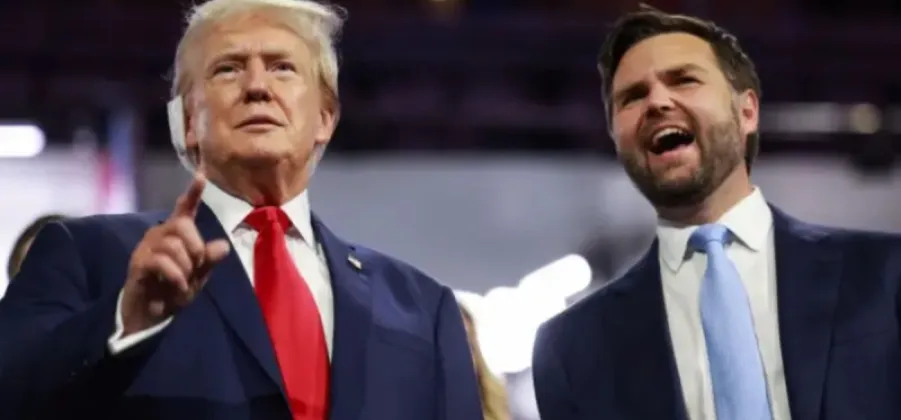
US President Donald Trump said on Tuesday that it is too early to discuss who might succeed him, when asked in the Oval Office whether he would support Vice President JD Vance as a presidential candidate in the 2028 election. Speaking to reporters at the White House, with Vance standing behind him, Trump praised his vice president but declined to commit to endorsing a potential candidacy, leaving the question of his political inheritance open even as speculation about the next presidential cycle gathers pace.
Praise, but no promise
The question was put to Trump during his interaction with reporters in the Oval Office, the traditional stage for presidential statements and, just as often, for pointed political questions. Asked whether he would back Vance as the Republican candidate in 2028, Trump replied that it was too early to be discussing a successor to the presidency. The remarks were reported by Nagarik News and Khabarhub.
Trump's response combined warmth with caution. He spoke appreciatively of Vance, a reflection of the vice president's standing within the administration, but he stopped short of the full-throated endorsement that would effectively clear the path for his deputy. For a president whose pronouncements are watched closely for signals about the Republican Party's future, the decision to hold back was itself notable.
The setting added its own layer of significance. Vance stood behind the president throughout the exchange, present in the room as his own political future was discussed. The vice president did not need to say a word for the moment to underline the unusual dynamic of the current White House: the question of succession is already being asked, openly, in front of the very person the question concerned.
Why 2028 is already a live question
The reason the question arises at all lies in the US Constitution. Trump is serving his second term in the White House, and under the Constitution's two-term limit he cannot stand for the presidency again. That makes 2028 the next election at which Republicans must choose a new standard-bearer, and it explains why speculation about potential candidates has begun long before any votes are cast.
Vance occupies a central position in that conversation by virtue of his office. Having run alongside Trump in the 2024 election and assumed the vice presidency in January 2025, he is among the most visible figures in the Republican Party and appears beside the president at official events, as he did on Tuesday. Vice presidents have historically used the platform as a springboard for presidential bids, and Vance's daily visibility keeps his name in circulation as the party looks toward the future.
The reporter's decision to raise the subject directly with the president, and to do so with Vance standing in the room, reflects how much attention the 2028 contest is already attracting, even though the first nominating contests remain years away.
What Trump's answer means for Vance
An endorsement from Trump carries particular weight within the Republican Party, and his refusal to offer one at this stage leaves the field unsettled. For Vance, the calculus is delicate. Declaring a candidacy too soon, without the president's explicit blessing, could be read as an act of impatience, while waiting indefinitely risks ceding ground to other figures who may choose to organize earlier. Trump's praise, offered on Tuesday without any accompanying commitment, preserves the vice president's position while withholding the one asset that would decisively transform it.
Key points from the Oval Office exchange
- Trump said on Tuesday that it is too early to discuss a successor to the presidency
- He was asked in the Oval Office whether he would support JD Vance as the 2028 Republican presidential candidate
- Trump praised Vance but declined to commit to endorsing his potential candidacy
- Vance was standing behind the president as the question was answered
The long road to the nomination
There is little procedural pressure for an early decision. The Republican Party will not select its presidential nominee until its national convention in the summer of 2028, and the primaries and caucuses that decide the contest will unfold in the months before that. Endorsements of the magnitude at stake here have historically carried the greatest force when delivered closer to voting, a rhythm that gives Trump ample time before he must choose whether, and when, to weigh in.
For now, Tuesday's exchange leaves the situation precisely where Trump appears to want it. His vice president has been praised in public and identified, implicitly, as a worthy subject of the succession question, but nothing has been promised and nothing has been closed off. As the 2028 race takes shape over the coming years, the moment in the Oval Office is likely to be remembered less for what Trump decided than for what he chose to defer.