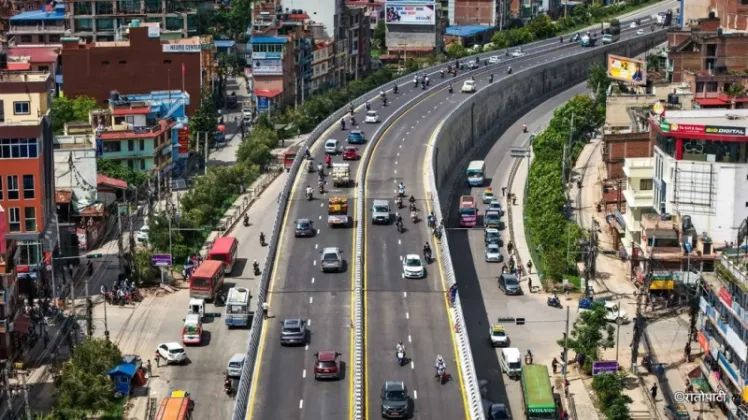
Traffic congestion increased on roads across the Kathmandu Valley on Wednesday as people travelled to receive Vijaya Dashami tika, jamara and blessings from elders, restoring movement to streets that had remained largely quiet through the opening days of the Bada Dashain festival. Vehicle numbers rose after the tika auspicious hour, according to traffic police, marking a clear change from Fulpati, Maha Ashtami and Maha Navami, when traffic across the capital and its surrounding districts had thinned noticeably. Public transport is also seeing growing crowds as festival-goers move between the homes of relatives in Kathmandu, Bhaktapur and Lalitpur. Despite the rising volume, police said vehicles were operating normally on the main roads of all three districts, including at the main entry points into the Valley. As reported by Ratopati and Khabarhub, the day's traffic traced the shape of the festival itself, shifting from the hush of the ninth day of Dashain to the family movement of the tenth.
From quiet festival days to busy Valley roads
Kathmandu had worn an unfamiliar calm through the middle of Dashain. On Maha Ashtami and Maha Navami, the Valley was largely quiet, with vehicle movement reduced on many roads as households observed the festival at home. The lighter pattern held through Fulpati and the days that followed, giving the capital a slower rhythm than usual during one of the most festive stretches of the Nepali year.
That rhythm changed quickly on Wednesday. Once the auspicious hour for receiving tika passed, people began heading to the homes of parents, grandparents and other elders across the three districts, and traffic began building on the main roads of Kathmandu, Bhaktapur and Lalitpur. Traffic police confirmed that vehicle numbers rose after the tika hour compared with Fulpati, Ashtami and Navami, underlining how sharply the Valley turned from stillness to movement on the festival's most important day.
The contrast between the two phases of the festival could hardly have been sharper. Roads that had carried only light traffic during Ashtami and Navami were soon hosting the familiar festival-season mix of private vehicles and crowded public transport, as families fanned out across the three cities to complete their rounds of tika and blessings.
Police report normal flow despite growing congestion
While congestion has increased, the assessment from traffic police remained reassuring. According to officers, vehicles are operating normally across the main roads of the Valley, and the situation at the main entry points has remained orderly even as more vehicles join the roads.
According to the traffic police:
- Vehicles are operating normally on main roads in Kathmandu, Bhaktapur and Lalitpur.
- Movement has remained normal at the main entry points into the Valley.
- Vehicle numbers rose after the tika auspicious hour on Wednesday compared with Fulpati, Ashtami and Navami.
The rising vehicle count has brought visible congestion to Valley roads, but the police characterization indicates that traffic continues to move, with the festival-day surge in movement absorbed on the capital's principal routes.
Crowds grow on public transport
Public transport has seen a parallel rise in demand. As families set out for tika ceremonies across the three districts, crowds on public vehicles have grown through the day, adding to the overall pressure on Valley roads. The scale of Dashami travel, when large numbers of people move across the Valley in the course of a single day to receive blessings and return home, is a principal reason the roads are busier now than they were only a day earlier.
The pattern reflects the distinctive shape of Vijaya Dashami within the longer festival. While the preceding days are marked by worship and observance at home, the tenth day is defined by travel between households, as younger relatives make their way to elders across Kathmandu, Bhaktapur and Lalitpur.
Tika, jamara and the pull of family
Vijaya Dashami sits at the heart of Bada Dashain, the biggest festival in Nepal. The celebration builds through Fulpati, Maha Ashtami and Maha Navami before culminating on the tenth day, when elders apply tika to the foreheads of younger relatives, offer them jamara and give blessings for their wellbeing. The ritual draws extended families together and sends people across towns and neighbourhoods to reach those gatherings.
It is precisely this movement that reshaped the Valley's traffic on Wednesday. The same city that had slowed to a near standstill during Ashtami and Navami found its roads busy again as people made their rounds of elders' homes, with the flow continuing through the day after the auspicious hour. For traffic police, the festival's most important day has so far brought heavier roads but steady movement; for the families of the Valley, it has brought the reunions and blessings that sit at the centre of the Dashain celebration.