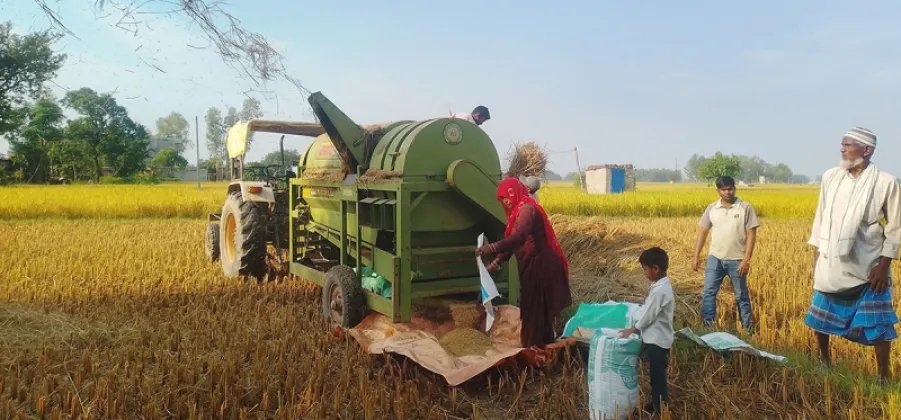
When talk of the future turns, for so many young Nepalis, to passports and the promise of wages abroad, Amjat Ali Sheikh of Banke district offers a quiet counterpoint. A resident of Nepalgunj Sub-Metropolitan City-19, he has spent the past seven years earning his living by operating a thresher machine, a venture that began with an investment of Rs 350,000 and now brings him up to Rs 150,000 in a single paddy season. As reported by Nagarik News, Khabarhub and Ratopati, his work has eased the burden on local farmers and created employment in the village, at a time when many young people are leaving the country for foreign jobs.
Seven seasons behind one machine
Paddy dominates the agriculture of the Tarai plains, where Banke lies, and every harvest leaves farming households facing the same urgent task: separating the grain from the stalks and husks before the crop can be lost. That annual rhythm defines Sheikh's work. When the paddy comes in, his machine comes into its own, and the season's earnings follow.
The essentials of the venture are simple:
- Investment: Rs 350,000 in a thresher machine
- Experience: seven years of continuous operation
- Earnings: up to Rs 150,000 during the paddy season
- Location: Nepalgunj Sub-Metropolitan City-19, Banke
Behind those figures lies a rare achievement in rural Nepal: income built without a departure. Seven years of steady operation indicate that the machine has long since repaid its cost and that demand for threshing services in his area is strong enough to sustain the business year after year. Sheikh did not wait for a job offer or a visa; he invested in a service his neighbors need at every harvest and turned it into his livelihood.
Relief for farmers when it matters most
Threshing by hand is among the most punishing stages of rice farming. After months of nurturing a crop from seedling to grain, a household must quickly separate the paddy from the straw, work that traditionally meant days of exhausting labor with the whole family pressed into service while the harvested crop sat exposed to the weather. In villages where working hands are increasingly scarce, that difficulty has only grown.
A machine like Sheikh's compresses the task into a fraction of the time. Grain is separated quickly and cleanly, losses are reduced, and farmers are spared the scramble to find workers at the very moment every farm in the neighborhood needs them. It is this relief that local farmers have come to depend on, and it is why his small operation has become a fixture of the harvest season in his area.
Employment that stays home
His machine does more than serve its customers; it generates work where it stands. Running and maintaining a thresher through the busy season requires labor, and the money earned is spent in the local market rather than sent home from some distant worksite. In a settlement where paid opportunities are few, one machine has become a modest but genuine source of employment within the village.
An answer to the outmigration question
The backdrop to Sheikh's success is one of Nepal's most persistent challenges: the steady departure of its youth. Large numbers of young Nepalis seek foreign employment every year, drawn by wages that village economies struggle to match, and the remittances they send sustain households across the country. The cost, however, is visible in the farms tended by the elderly and the communities drained of working-age energy.
Measured against that reality, seven years behind a thresher carries meaning beyond one man's earnings. Sheikh's case shows that opportunity does exist within the agricultural economy for those willing to invest in it, and that a machine meeting a common farming need can anchor a sustainable business. His example matters precisely because it is ordinary: an investment, a service that neighbors genuinely need, and the persistence to keep at it.
None of this dissolves the structural pressures that push youth abroad. Farm income remains seasonal and vulnerable to the weather, and a single thresher in a single ward cannot transform a village economy on its own. But the story points to where some answers may lie: in mechanizing the farm work that still anchors rural life, and in making self-employment at home a credible alternative to a plane ticket.
For the farmers of Nepalgunj Sub-Metropolitan City-19, the meaning is simpler still. Every paddy season, when the harvest is heavy and the days are short, there is a machine close at hand and a young operator behind it, and the grain comes off the stalk in good time. For Amjat Ali Sheikh, that service has meant seven years of self-reliance, earned without ever having to leave home.