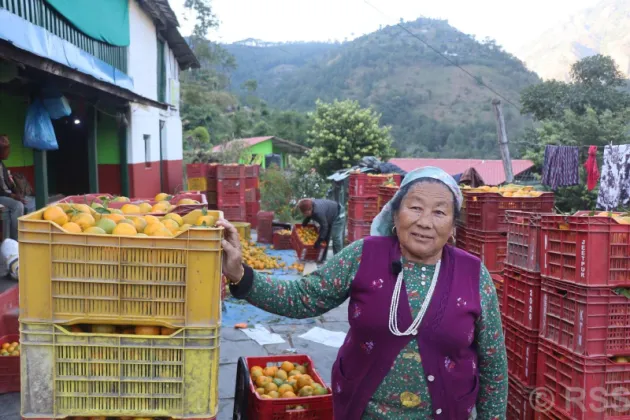
Farmers of Surkemela in Beni Municipality-4 of Myagdi district have transformed their agricultural landscape by replacing traditional food crops with orange orchards, turning land that once yielded rice, millet, maize and wheat into a source of millions of rupees in annual income. The shift, driven by the growing difficulty of sustaining grain farming, has not only boosted household earnings but also changed the lifestyle of farming families in the hilly settlement.
From Grain Fields to Orange Orchards
For generations, the terraced fields of Surkemela produced staple grains. Farmers grew rice, millet, maize and wheat to feed their families and sell any surplus in local markets. However, as traditional grain farming became increasingly difficult to sustain, both economically and practically, the farmers began looking for alternatives that suited their land and labour conditions.
Citrus farming emerged as that alternative. Orange saplings planted across the village have matured into productive orchards, and the fruit now generates income in the millions of rupees from the very same plots that once produced modest grain harvests.
The experience of Bal Kumari Roka, 65, of Surkemela illustrates the scale of the transition. Fourteen years ago, she planted orange saplings in a field that had previously produced seven muri of rice. Today, that decision has made orange farming her primary source of income, and her story has become emblematic of the wider change sweeping through the village.
Millions in Income from the Same Land
The economic turnaround has been striking. Where grain cultivation offered limited returns and mounting challenges, orange farming has opened new commercial opportunities for Surkemela's farmers. Selling oranges has enabled families to earn millions of rupees, a level of income that traditional food crops could not match on the same land.
According to reports, the shift has done more than raise incomes. It has changed the farmers' lifestyle, bringing greater financial security and altering daily routines in the settlement. The orchards have become central to the village economy, and success stories like Roka's have encouraged further adoption of citrus cultivation among local farmers.
The suitability of Myagdi's hills for orange farming has worked in the farmers' favour, allowing them to convert marginal grain terraces into productive orchards without abandoning their land or migrating for work.
Challenges: Labour Shortage and Beyond
Despite the commercial success, the transition has not been without difficulties. Reports citing the farmers highlight a shortage of manpower as a key challenge facing orange farming in Surkemela. As with many hill communities in Nepal, the availability of agricultural labour has become a growing concern, particularly during labour-intensive periods such as harvesting.
The labour shortage adds pressure on farming households, many of which rely on ageing family members to manage orchards. Farmers like 65-year-old Roka represent a generation that carried out the transition to citrus farming, and sustaining that momentum will require addressing the workforce gap.
A Model for Agricultural Diversification
The Surkemela experience reflects a broader trend of agricultural diversification in Nepal's mid-hills, where farmers are moving away from subsistence grain farming toward cash crops that offer better returns. In Myagdi, the shift from rice, millet, maize and wheat to oranges has demonstrated that alternative crops can revitalize farming communities when matched to local conditions.
The transformation of Surkemela's fields, once measured in muri of rice, now measured in millions of rupees, stands as evidence of how a deliberate change in cropping patterns can reshape rural livelihoods. As orange farming continues to expand in Beni Municipality, the village's farmers have set an example of adapting to changing economic realities while remaining rooted in their land.
Farmers and local observers will be watching whether the challenges of manpower shortage can be addressed in time to sustain the momentum that the orange orchards have brought to this Myagdi settlement.