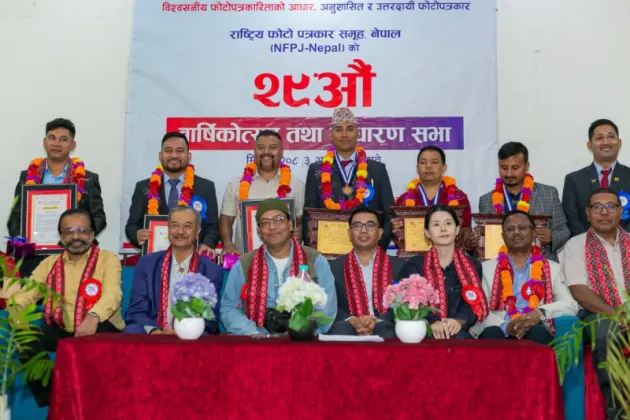
Seven photo journalists were honoured for excellence in their respective categories at the 29th annual general assembly of the National Photo Journalists Group Nepal (NFPJ), held in Hattisar, Kathmandu. The assembly also discussed ways to strengthen photo journalists’ professional capacity, protect their rights and interests, secure copyright and make the organisation financially self-reliant.
Recognition for photo journalism
The honours placed recognition of work in different categories at the centre of the assembly’s proceedings. Seven journalists received awards for excellence, acknowledging achievements across their respective fields. The assembly’s focus on category-based recognition highlighted the range of work represented in photo journalism, while the event brought that recognition together with discussion of the profession’s broader needs.
The available details do not specify the names of the recipients or list the categories in which they were honoured. The central point reported from the event is that seven photo journalists were recognised for their excellence. The awards were part of the NFPJ’s 29th annual general assembly, which also considered organisational and professional priorities beyond the ceremony.
Professional capacity and rights
Developing the professional capacity of photo journalists was among the matters discussed. This placed skills and professional growth alongside recognition as a key concern for the organisation. The assembly considered how the capacity of photo journalists could be strengthened, although the details provided do not identify particular training programmes, proposals or decisions adopted during the discussion.
Members also discussed protecting the professional rights and interests of photo journalists. The issue was raised as part of the assembly’s consideration of the conditions needed to support the profession. It was discussed together with copyright, another concern directly tied to the work and interests of photo journalists. The reported agenda did not set out specific measures or explain whether any formal commitments were made.
- Professional capacity: The assembly discussed strengthening photo journalists’ professional capabilities.
- Rights and interests: Participants considered the protection of photo journalists’ professional rights and interests.
- Copyright: Safeguarding copyright was also included in the discussion.
- Financial self-reliance: The organisation’s ability to become financially self-reliant was another stated priority.
Copyright and organisational sustainability
Copyright formed a distinct part of the assembly’s agenda. Its inclusion alongside professional rights and interests underscored that the group’s discussion covered both the development of photo journalists and protections connected to their work. The information available from the assembly does not detail a specific copyright policy, enforcement plan or other measure, but identifies the issue as one the organisation considered important.
The assembly also discussed making NFPJ financially self-reliant. That goal placed the organisation’s own sustainability alongside the professional concerns of its members. The discussion connected the future strength of the group with a practical organisational question: how it can build greater financial independence. No particular funding plan or timeline was specified in the reported details.
Taken together, the assembly addressed four broad priorities: professional development, protection of rights and interests, copyright and financial independence. These topics framed the meeting as both a recognition event and a forum for discussion about the organisation and the profession. The honours recognised seven individuals, while the agenda also turned to issues that the group identified as relevant to photo journalists and NFPJ’s future.
The 29th annual general assembly was held in Hattisar, Kathmandu. Its proceedings combined the recognition of excellence in respective categories with discussion of how to develop professional capacity, protect members’ interests and support the organisation’s financial self-reliance. The reported details do not identify further resolutions, but establish these matters as the principal issues raised at the gathering.