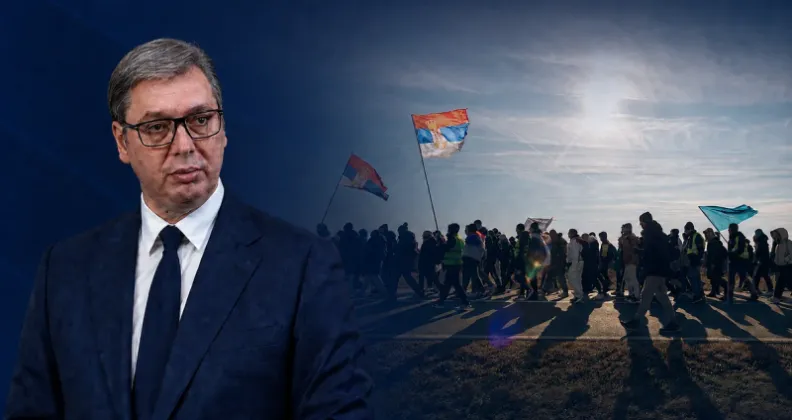
Serbia votes on Sunday in a parliamentary election that has become the sharpest test yet of President Aleksandar Vučić's long hold on power, with an anti-corruption student movement mounting a formidable challenge to the country's entrenched leadership. Vučić's Serbian Progressive Party (SNS), the dominant force in Serbian politics for years, now faces a headline challenge from the Student List, an electoral slate that emerged directly from the wave of student protests that has shaken the country. The contest, closely watched in the capital Belgrade and across the country, is now widely seen as increasingly competitive, a marked shift in a political landscape long shaped by the president's party.
From the streets to the ballot box
The defining feature of this election is the arrival of the Student List, an opposition grouping born out of the student protest movement. The movement's core grievance is corruption, and it has carried that message from campuses and protest marches into the campaign itself, offering voters an alternative that is neither a traditional party nor a conventional political machine.
The decision to stand candidates marks a decisive shift in tactics. Rather than channelling demands solely through demonstrations, the movement has chosen to test its strength at the ballot box, betting that the energy visible in the protests can be converted into votes and that anti-corruption sentiment can be organised into parliamentary seats.
For voters, the choice presented is stark. The Student List represents a new and untested force, while the SNS offers continuity and the full machinery of incumbency. How that choice resolves itself on Sunday will say much about the direction of the country, and about whether protest movements can translate street momentum into lasting political power.
Vučić and the SNS face a real fight
Vučić has ruled Serbia for years, and his Serbian Progressive Party enters this vote as the party of government, with all the advantages that status entails. Yet the president now finds himself facing a challenge unlike the conventional opposition contests of the past. The Student List is not an established party with a long record to defend; it is a movement with fresh energy and a clear anti-corruption message, and it has succeeded in making this election interesting in a way that recent campaigns have not been, as reported by Ratopati and its English service.
The stakes for the SNS are correspondingly high. A strong result would confirm the party's dominance and blunt the protest movement's momentum. A weaker-than-expected showing, by contrast, would signal that the students have fundamentally altered the calculus of Serbian politics and would raise pointed questions about the durability of Vučić's rule. It is precisely this uncertainty, reports suggest, that has turned what might have been a routine parliamentary vote into a genuinely open contest.
For the movement itself, the election is a moment of proof. Its supporters argue that the scale of the protests already demonstrates the depth of public frustration; its critics counter that enthusiasm in the streets does not automatically become support at the polling station. Sunday's result will go a long way toward settling that argument.
A competitive race in Belgrade and beyond
Geography matters in this election. The contest is seen as especially tight in Belgrade, the capital and the country's political centre of gravity, and the competitiveness extends across Serbia as a whole. For a party long accustomed to comfortable victories, the prospect of a close race on its home terrain underscores how far the political ground has shifted in the lead-up to the vote.
Belgrade's significance is more than symbolic. As the seat of government and the stage on which much of the protest activity has played out, it is where the mood of the electorate is most visible, and where a strong student showing would carry the greatest resonance. A competitive race in the capital also complicates any assumption that the outcome is a foregone conclusion.
The national dimension is equally important. A parliamentary election determines the composition of the country's legislature and, with it, the governing party's ability to set policy. If the Student List performs strongly, it would gain a platform from which to press its anti-corruption agenda from inside the political system. If it falls short, the movement will face hard questions about whether its moment has passed or whether its challenge will simply continue in another form.
The race at a glance
- When: A parliamentary election is being held on Sunday.
- The main contest: Vučić's Serbian Progressive Party (SNS) versus the Student List, which emerged from the student protests.
- The central issue: Corruption, the grievance at the heart of the student movement.
- The dynamic: An increasingly competitive race in Belgrade and across the country.
Whatever the outcome, this election already stands apart. A movement born in the streets has forced Serbia's long-dominant political establishment onto the defensive and turned a routine parliamentary vote into a national moment of reckoning. Serbian voters will deliver their verdict when polling concludes on Sunday, and the result will shape not only the next parliament but the trajectory of the protest movement that reshaped the campaign itself.