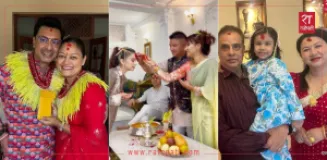
On the second day of Bada Dashain, people across Kathmandu and other parts of the country spent the day visiting the homes of relatives and respected elders to receive tika and jamara, the prasad of Navadurga, as the main ritual of Nepal's biggest festival continued beyond Vijaya Dashami. According to RatoPati, those who received tika within their own families on the day of Dashami are now travelling to distant relatives and dignitaries, keeping alive a tradition of blessings that will run until Purnima, the full moon day that concludes the festival.
For households across the capital and beyond, the second day of the festival carried the same warmth and ritual as the day before. Elders seated at home welcomed a fresh stream of younger relatives, applying tika on their foreheads, offering jamara, and blessing them with wishes for good health, long life and prosperity. Pradesh Khabar reported that the practice of exchanging tika, jamara and blessings remained in full swing as people moved from one home to another.
Beyond the family circle
While Vijaya Dashami is traditionally the day when tika is received within one's own family, the second day of Bada Dashain carries the observance outward. Those who took tika from their parents and immediate elders on Dashami set out for the homes of distant relatives and respected figures in their wider circle, seeking their blessings in turn.
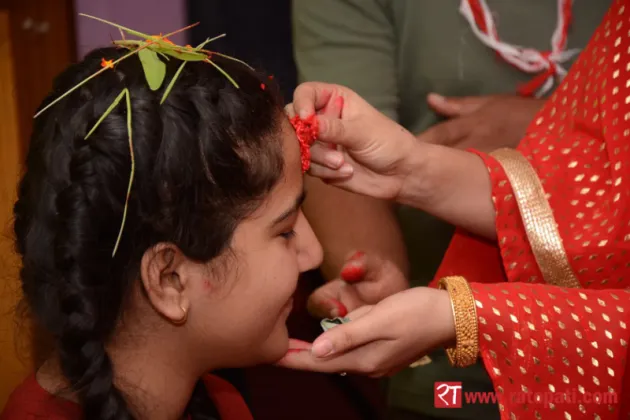
This second round of visits is an integral part of how the festival unfolds. Younger relatives travel across neighbourhoods, towns and even districts to reach the elders they could not meet on the main day. In each home, the ritual is repeated: the younger person bows, the elder applies tika, places jamara on the head or behind the ear, and offers words of blessing. What began as a family observance on Dashami thus extends outward, drawing in uncles and aunts, in-laws, grandparents and other seniors over the days that follow.
Tika and jamara: the prasad of Navadurga
The two items at the heart of the ritual carry deep religious meaning for Nepali Hindus. Both are treated not merely as decorations but as sacred offerings, the prasad of Navadurga, the nine forms of the goddess worshipped throughout the festival.
- Tika is a mixture of rice grains, red vermilion and yogurt, applied by elders on the forehead of the younger person as a mark of blessing.
- Jamara consists of the tender yellow-green shoots of barley and other grains, which are germinated on the first day of the festival and nurtured in the days that follow.
- Together, the tika and jamara symbolise the blessings of the goddess as mediated through the elders of the family and community.
By the second day of Dashain, these offerings have already been distributed within countless families on Vijaya Dashami, and the same prasad now travels with relatives and friends as they make their rounds. The act of receiving tika and jamara from an elder is understood as an expression of humility and respect, while the blessings given in return bind the generations together.
A tradition that continues until Purnima
The exchange of tika and jamara on the second day is not the end of the observance. As reported, the practice of giving and receiving tika, jamara and blessings continues until Purnima, the full moon day that marks the conclusion of the festival. This extended timeline is one of the distinctive features of Dashain: rather than a single day of ritual, the festival stretches across many days, allowing families the time to visit elders who live apart from them.
For elders, the days after Dashami are spent receiving guests, applying tika and offering blessings to the stream of younger relatives who arrive at their doors. For the younger generation, the period is an opportunity to reconnect with seniors they may not see through the rest of the year, to renew relationships with distant relatives, and to seek the good wishes that the festival places at the centre of its observance.
Blessings that bind generations
The second day of Bada Dashain underscores what the festival is ultimately about for many families: the reaffirmation of bonds between generations and across the extended family network. The tika on the forehead and the sprigs of jamara carried home after each visit are outward signs of a relationship renewed, of respect offered and blessings received.
As the rounds of visits continue in Kathmandu and elsewhere in the days ahead, the tradition will carry on in the same manner until Purnima. Each visit adds another home, another elder and another blessing to the tally of the festival, ensuring that the spirit of Bada Dashain, embodied in the simple yet profound act of receiving tika and jamara from those one respects, remains alive from Vijaya Dashami all the way to the full moon.