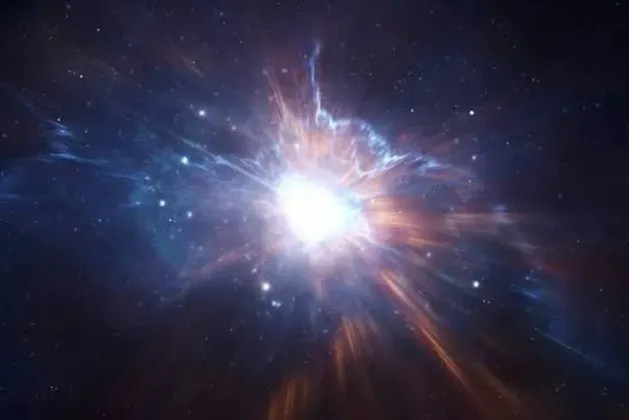
Scientists have discovered the farthest quasar known so far, an extraordinarily luminous object that formed just about 630 million years after the Big Bang, a German-led research team announced on Tuesday. The quasar dates back to a remarkably early phase in the universe's 13.8 billion-year history, and its central supermassive black hole is already offering new insights into how galaxies evolved in the cosmos's infancy.
A Window Into the Early Universe
Quasars are among the brightest objects in the universe, powered by enormous amounts of gas and other matter falling into the supermassive black holes at the centers of galaxies. As the matter spirals inward, it heats up and releases tremendous energy, making quasars visible across vast cosmic distances.
Because light from distant objects takes billions of years to reach Earth, observing a quasar that formed 630 million years after the Big Bang effectively means looking back to a time when the universe was still very young. The newly discovered object therefore serves as a kind of time machine, allowing astronomers to study conditions in the early universe that are otherwise impossible to observe directly.
Insights Into Galaxy Evolution
The central supermassive black hole of the newly found quasar provides researchers with a rare opportunity to investigate how galaxies grew and evolved in the universe's first few hundred million years. The presence of such a massive black hole at such an early epoch raises important questions about how quickly these objects could form and grow after the Big Bang.
Understanding how supermassive black holes formed so early in cosmic history is one of the key challenges in modern astrophysics. Discoveries like this one help scientists test competing theories about the growth of the first black holes and their role in shaping the galaxies that surround them.
An International Discovery
The findings were announced on Tuesday by a research team led from Germany, according to reports. The announcement marks a significant milestone in the ongoing search for the most distant and therefore earliest objects in the universe.
Astronomers have expressed surprise at the discovery of a giant quasar so soon after the Big Bang, underscoring how much remains to be learned about the rapid formation of massive structures in the early cosmos. As observations of the object continue, researchers hope to learn more about the properties of the black hole, the galaxy hosting it, and the state of the universe at that early time.
The discovery adds to a growing body of knowledge about the early universe, complementing observations of the most distant galaxies and providing new data points in humanity's effort to reconstruct the first chapters of cosmic history.