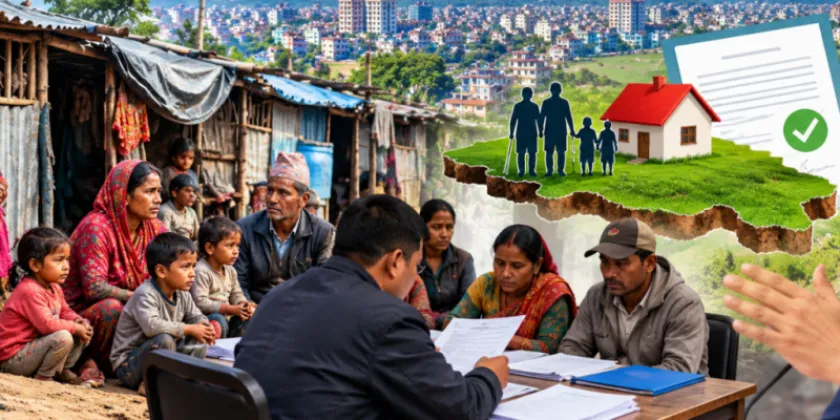
The District Squatter Problem Resolution Committee has listed 10,000 landless squatters and more than 72,000 unmanaged settlers across Rupandehi district, according to figures reported by Nepali media outlets on October 19 and 21, 2026. The committee compiled the district-wide record as of the end of Asoj, the sixth month of the Nepali calendar, which runs from mid-September to mid-October. The listing covers both people identified as landless squatters and households living in unmanaged, or unorganized, settlements throughout the district.
More Than 82,000 Entries Across Rupandehi
Taken together, the two categories place more than 82,000 entries on the district's squatter and landlessness record, one of the largest such counts reported for a single Nepali district. The far larger share belongs to unmanaged settlers: at more than 72,000, they outnumber the 10,000 landless squatters by roughly seven to one.
The key figures reported from the committee are as follows:
- 10,000 landless squatters listed in Rupandehi district.
- More than 72,000 unmanaged settlers recorded in unorganized settlements.
- A combined total of over 82,000 entries as of the end of Asoj.
- The record covers both categories, landless squatters and unmanaged settlers, across the entire district.
The reports did not break the figures down further by municipality, ward or settlement site, so the district-level totals remain the most detailed numbers available from the published summaries. No revised or updated tally has been reported since the end-of-Asoj snapshot.
Two Labels, One Listing Exercise
The committee's record distinguishes between two groups that Nepali land administration generally treats separately. Landless squatters are people who do not hold registered ownership of the land they live on and have settled on land belonging to others, most often public or government land. Unmanaged settlers, referred to in one of the published headlines as "unorganized settlements," are residents of settlements that have grown without formal planning, registration or serviced infrastructure.
By listing both groups in a single district-wide exercise, the committee has produced a consolidated picture of insecure housing and land tenure in Rupandehi. The distinction matters in practice: the two categories typically call for different forms of resolution, and separate counts allow authorities and observers to track the scale of each problem independently. The published summaries did not, however, explain the methodology the committee used to identify and verify the families on the list, nor whether individual households can appeal their classification.
A Mid-October Data Point
The timing of the figures is significant. The count is dated to the end of Asoj, meaning it reflects the situation on the ground in mid-October 2026. The numbers were then reported publicly on October 19 and 21, 2026, by two Nepali outlets, Nepal Press and Nepal Views, both of which attributed the figures to the District Squatter Problem Resolution Committee.
Because such lists are periodically revised as families are added, verified or removed, the end-of-Asoj totals represent the latest published snapshot for the district. Any future updates, whether upward through new identification or downward through resolution of individual cases, would need to be measured against this baseline. The available reports did not indicate when the committee expects to publish a revised count.
Context: Landlessness and Informal Settlements
Landlessness and informal settlement are long-standing challenges in Nepal, and district-level squatter problem resolution committees are the bodies tasked with identifying affected families and working toward solutions at the local level. Identification drives of this kind are generally the foundation on which any subsequent resolution measures rest, since authorities cannot address settlements they have not first documented.
Rupandehi, in Lumbini Province, is among Nepal's growing districts, with expanding urban centres, trade links and transport connections that draw people in search of work and opportunity. Rapid growth of this kind is often accompanied by the spread of unplanned settlements, which helps explain why the unmanaged settler figure is so much larger than the landless squatter count in the committee's record.
What happens next was not detailed in the published reports. The summaries did not specify whether the listing will lead to verification drives, relocation, registration, the provision of land or other resolution measures, and neither outlet quoted committee officials on follow-up plans. That leaves open the central question raised by the numbers: how the district will translate a record of more than 82,000 entries into concrete action for the families it describes.
For now, the figures offer the clearest recent measure of the scale of insecure settlement and landlessness in Rupandehi. With more than 72,000 unmanaged settlers and 10,000 landless squatters on the books as of the end of Asoj, attention will turn to whether the committee publishes updated totals and announces any steps toward resolving the cases it has documented. Both reports remain available online for readers seeking the original coverage.