The Newar community of Bhaktapur celebrated Mohani Nakhah on Wednesday, marking the day of Vijaya Dashami with rituals that bear a distinctly Newar character. In households across the historic city, younger family members received Mohani Sinh, the ceremonial black and red tika together with jamara, from the hands of their elders. The celebration also drew on preparations made a day earlier, when households lit lamps in palas as part of the worship of Navadurga Bhawani on Maha Navami, and the soot that gathered on those lamps was collected for use in the Dashami observance. Local media, including Nepal Press and Khabarhub, reported on the festivities.
Tika and jamara from the hands of elders
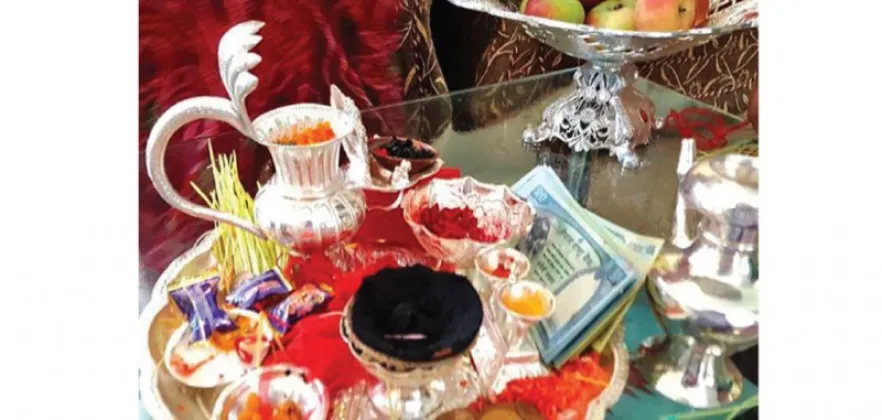
At the heart of Mohani Nakhah lies the ritual of Mohani Sinh, the ceremonial marking that defines the day for Newar families. Elders applied the black and red tika and presented jamara to the younger members of their households, completing an exchange in which the good wishes of one generation pass directly to the next. Because the tika and jamara are received from the hands of elders rather than simply self-applied, the moment carries a weight that goes beyond ritual formality, binding families together in a shared act of respect and affection.
The two-tone tika, in black and red, stood out as the defining feature of the celebration. Paired with jamara, it marked those who received it as participants in the central rite of the day. For families in Bhaktapur, the practice turns Vijaya Dashami into an intimate household occasion, in which the courtyard and the family room, rather than any public square, become the setting of the festival.
The ritual also embodies continuity. Elders who once received Mohani Sinh from their own elders now stand on the giving side, passing the same tika and the same jamara down the line. In this way the observance renews itself with each Dashami, carried forward in the hands of each new generation.
Lamps for Navadurga Bhawani
The celebration on Wednesday rested on preparations made on Maha Navami, the ninth day of the festival and the eve of Vijaya Dashami. As part of the worship of Navadurga Bhawani, households in Bhaktapur lit lamps in palas, the traditional lamps used in Newar ritual practice. The lighting of these lamps formed the devotional heart of the Navami observance, connecting the household directly with the goddess.
From those burning palas came the element that would carry into the following day. The soot that settled on the lamps was collected and used in the Mohani Nakhah celebration, so that the worship performed on Maha Navami flowed naturally into the tika giving of Vijaya Dashami. The sequence gives the two days the shape of a single arc, with devotion offered on the ninth day and its traces carried into the tenth.
Navadurga Bhawani holds a central place in the religious life of the Newar community, and the link between Mohani Nakhah and the goddess is one that the community itself emphasises. The festival is celebrated as a joyful occasion and is closely tied to the worship of Navadurga, giving the Dashain season a devotional dimension that runs alongside the tika and jamara familiar to celebrants across the country.
The rituals at a glance
- Mohani Sinh: the ceremonial black and red tika and jamara received from elders on Vijaya Dashami.
- Palas lamps: lamps lit in households on Maha Navami as part of the worship of Navadurga Bhawani.
- Collected soot: the deposit that gathered on the palas lamps, used in the celebration the following day.
- Elders and juniors: tika and jamara given directly from the hands of the older generation to the younger one.
A Newar observance within the Dashain season
Mohani Nakhah runs parallel to Vijaya Dashami, the tenth day of the Dashain festival observed across Nepal. While the wider celebration centres on the reception of tika and jamara, the Newar observance in Bhaktapur adds its own layer of ritual, from the black and red of the Mohani tika to the soot of the palas lamps. The result is a festival that is at once familiar and distinct, recognisable to everyone who marks Dashain yet unmistakably Newar in its detail.
Bhaktapur provides a fitting stage for such an observance. The city, with its dense Newar population and carefully preserved traditions, remains one of the strongest centres of Newar culture, and festivals such as Mohani Nakhah are woven into the rhythm of life there. Wednesday's celebration followed that pattern, with households carrying out the rituals of the day in their own homes and courtyards.
For the Newar families of Bhaktapur, the day closed with the marks of the festival on their foreheads and the worship of Navadurga Bhawani at the centre of their observance. As the lamps of Maha Navami gave way to the tika of Dashami, Mohani Nakhah once again demonstrated how the community keeps its traditions alive within the larger current of the Dashain festival.