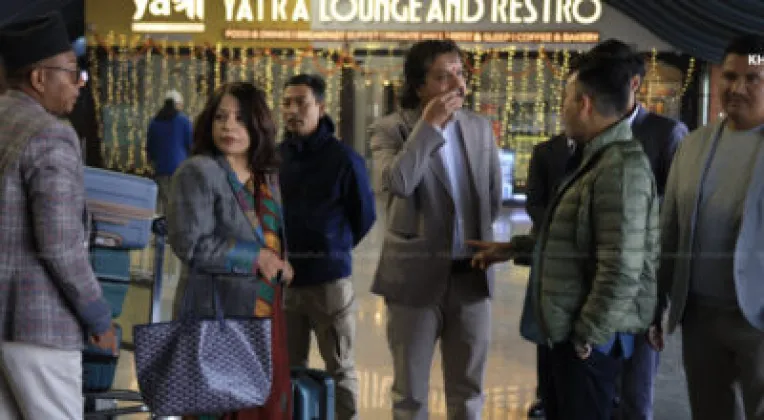
A high-level delegation of the Rastriya Swatantra Party (RSP) returned home on Thursday after completing a nearly two-week visit to China, undertaken at the invitation of the Communist Party of China (CPC). The delegation, led by the party's General Secretary Bipin Kumar Acharya, had travelled to the neighbouring country from November 15 to 26, visiting three major Chinese cities: Chengdu, Hangzhou and the capital Beijing. The visit concluded with the delegation holding high-level political talks with senior CPC leader Li Shulei, during which the two sides exchanged views on matters of mutual understanding and bilateral interest.
Invitation from the Communist Party of China
The trip was not a privately arranged tour but a formal invitation extended by the Communist Party of China itself, a detail that underlines the significance the CPC attached to engaging with the RSP. Party-to-party invitations of this kind are a common feature of Chinese diplomacy, through which the CPC maintains contact and dialogue with political parties across the spectrum in friendly neighbouring countries. By choosing to host a delegation of the RSP, one of the prominent forces in Nepal's contemporary politics, the Chinese party signalled its interest in broadening its engagement beyond any single political formation.
The itinerary itself reflected a layered approach to the visit. Rather than limiting the delegation to Beijing, the organisers included Chengdu, the capital of Sichuan province in southwestern China, and Hangzhou, the capital of Zhejiang province in the country's economically dynamic east. This structure allowed the delegation to experience China beyond the capital, taking in cities that represent different facets of the country's development before the final round of political talks in Beijing.
Talks with Senior CPC Leader Li Shulei
The centrepiece of the visit was the meeting with Li Shulei, a senior leader of the Communist Party of China. According to information shared after the delegation's return, the two sides held high-level political talks and used the platform to exchange views on mutual understanding and bilateral matters. While the specifics of the discussions have not been publicly detailed, the very holding of such talks at a senior level indicates that the dialogue covered the political relationship and issues of shared concern between the two parties and, by extension, the two countries.
For the RSP, the meeting offered an opportunity to present its positions directly to a senior interlocutor of the CPC. Party-to-party exchanges of this nature typically serve as channels through which visiting delegations convey their perspectives on bilateral cooperation, and through which the hosting party shares its own outlook. The exchange of views described after the visit suggests that both sides saw value in establishing or deepening this line of communication.
A Multi-City Programme Across Three Chinese Cities
The delegation's movement through Chengdu, Hangzhou and Beijing gave the visit both a political and an observational dimension. Chengdu, as a major urban centre of southwestern China, and Hangzhou, renowned as one of the engines of China's eastern economy, exposed the delegation to regions that are frequently showcased by Chinese hosts to visiting foreign political figures. The concluding stop in Beijing placed the delegation at the political centre of the country for the high-level meeting with Li Shulei.
Spreading the visit across nearly twelve days, from November 15 to 26, also gave the delegation an extended window in the country, a length of stay that goes beyond a brief ceremonial trip. The multi-city, multi-day format is consistent with how the CPC structures programmes for foreign delegations it wishes to engage in depth, combining political dialogue with exposure to Chinese cities and development.
The Return and What Lies Ahead
The delegation landed back in Nepal on Thursday, formally closing out the visit that began in mid-November. The return of the team led by General Secretary Bipin Kumar Acharya marks the end of the RSP's latest direct engagement with the Communist Party of China, an engagement that the party had undertaken at Beijing's own invitation.
Political observers and party watchers will now look to what follows. The stated outcomes of the visit, namely the high-level talks with Li Shulei and the exchange of views on mutual understanding and bilateral matters, provide a foundation on which future party-to-party contact between the RSP and the CPC could be built. Whether the visit leads to further exchanges, additional invitations or concrete cooperation will depend on the follow-up from both sides.
For now, the RSP has returned home from a visit that combined three Chinese cities, a senior-level meeting with a key CPC leader and nearly two weeks of direct engagement with one of Nepal's most important neighbours. The visit, conducted entirely at the invitation of the Communist Party of China, stands as a notable episode in the ongoing political interactions between Nepali parties and their Chinese counterpart.
This report is based on information published by Khabarhub.