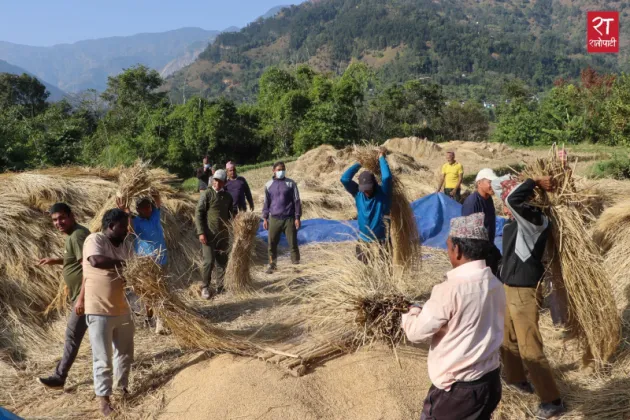
The Jaimini municipal committee of the Rastriya Janamorcha has cultivated rice collectively on 33 ropani of leased land at Binamare Chanauta in Jaimini Municipality-5, Baglung, treating the initiative as a labour camp. The party's municipal committee adviser, KB Thapa, said the harvest is now being brought in from the fields.
Farming the Land Others Left Behind
The collective farming drive was launched with a specific purpose: to bring back into production farmland that had gone barren as increasing numbers of villagers migrate out of the area. Rather than allowing the fields at Binamare Chanauta to sit unused, the party leased the land and mobilised its municipal committee members to farm it together.
Thapa explained that the programme was aimed at making productive use of the farmland left fallow due to out-migration from the villages. With fewer hands available in rural Baglung for traditional farming, large tracts of land across the district have steadily gone uncultivated, and the Janamorcha committee sought to demonstrate that such land can still be put to use through collective effort.
A Labour Camp Model
The initiative was organised in the form of a labour camp, with party members working together on the leased plot throughout the farming season. The 33 ropani of land at Binamare Chanauta, in Jaimini Municipality-5, was rented for the purpose, and the committee carried out the full cycle of rice cultivation on it, from planting through to the current harvest.
The rice grown on the plot is now being brought in, marking the completion of the collective farming effort for the season. The harvest represents the tangible outcome of the party's experiment in organising agricultural labour on land that had otherwise been lying idle.
Responding to Rural Out-Migration
The context behind the initiative is a familiar one for rural Nepal. As villagers leave in growing numbers for work and settlement elsewhere, farmland in many hilly districts, including Baglung, is increasingly left barren. The Janamorcha's municipal committee framed its collective farming as a direct response to this trend, seeking to show that barren fields can be revived when labour is organised collectively.
By leasing the land at Binamare Chanauta and farming it as a group, the Jaimini committee has offered an example of how local party structures and community organisations might step in where individual household farming is no longer viable. The harvest now under way is being watched as a demonstration of what collective effort can achieve on land that had gone to waste.
For Jaimini Municipality, where out-migration has hollowed out the agricultural workforce, the 33 ropani harvest stands as a practical statement from the Rastriya Janamorcha: that the village's land need not remain barren, provided someone is willing to work it together.