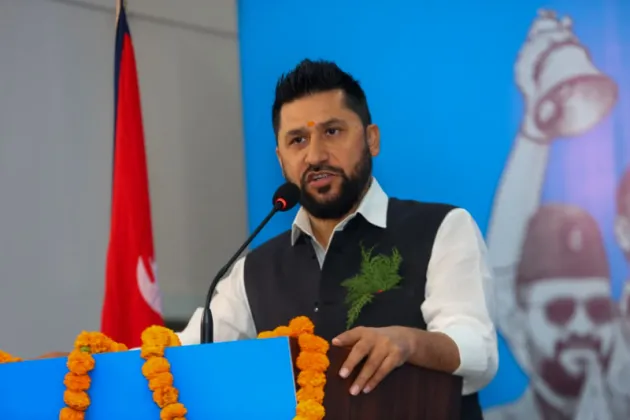
Rastriya Swatantra Party leader Rabi Lamichhane said on Saturday that there would be no bargaining of votes when it comes to the development of Karnali. Speaking on the issue, the former Deputy Prime Minister and Home Minister made it clear that his political side does not engage in any kind of deal-making with Karnali, a statement that has drawn attention given the province's long-standing development challenges.
The remarks were reported by Nepali news outlets Baahrakhari and Nepal Views on November 28, 2026, with Nepal Views carrying the story under the headline asserting that there is no bargaining for votes in the development of Karnali.
A Firm Statement on Development
Lamichhane's statement was direct: there can be no trade-offs or vote-bargaining linked to the development agenda of Karnali. In his remarks, he emphasized that his side does not engage in deal-making with the province, positioning development as a matter of principle rather than a bargaining chip in political negotiations.
The timing of the statement, made on a Saturday and reported the following day by media outlets, suggests it was delivered in the context of ongoing political discussions around the province. By framing development as non-negotiable, Lamichhane sought to draw a clear line between his political approach and the practice of trading political support for development commitments.
Why the Statement Matters for Karnali
Karnali Province, Nepal's largest province by area and among its least developed, has consistently figured in national debates over development priorities. Discussions about infrastructure, connectivity, and resource allocation in the province have often been entangled with broader political bargaining, making statements like Lamichhane's politically charged.
Against this backdrop, Lamichhane's assertion that there will be "no bargaining of votes over the development of Karnali" can be read as a response to that environment. By publicly stating that his side does not engage in deal-making with Karnali, he addressed head-on the perception that the province's development needs are sometimes used as leverage in political negotiations.
Reported Coverage
The statement reached the public through coverage by two Nepali news platforms. Baahrakhari and Nepal Views both reported the remarks on November 28, 2026, anchoring the statement to the Saturday appearance in which it was made.
- Lamichhane stated there will be no bargaining of votes over Karnali's development.
- He said his side does not engage in deal-making with Karnali.
- The remarks were made on Saturday and reported on November 28, 2026.
The consistency of the framing across both outlets, that development of Karnali is not something to be traded for votes, underscores that the statement was intended as a clear public position rather than an offhand remark.
Lamichhane's Political Standing
Rabi Lamichhane, a central figure in Nepal's political landscape as a leader of the Rastriya Swatantra Party, has previously served as Deputy Prime Minister and Home Minister. His public statements routinely attract significant media attention, and remarks touching on provincial development are closely watched for what they signal about his party's stance toward provinces such as Karnali.
His Saturday statement adds to the ongoing public conversation about how political parties approach Karnali's development needs. By explicitly ruling out vote-bargaining and deal-making, Lamichhane has placed his side on record with a position that development for the province should not be contingent on political exchanges.
What Lies Ahead
As reported, the substance of Lamichhane's remarks was limited to the core message: no bargaining of votes over Karnali's development, and no deal-making with the province from his side. The statement, carried by Baahrakhari and Nepal Views on November 28, 2026, now stands as a public commitment that observers and residents of Karnali may hold his political side to.
For now, the statement itself is the news. Whether it translates into concrete policy positions or further engagement with the province's development agenda remains to be seen, but Lamichhane has made his starting position unambiguous: when it comes to Karnali's development, there is nothing on the table for negotiation.