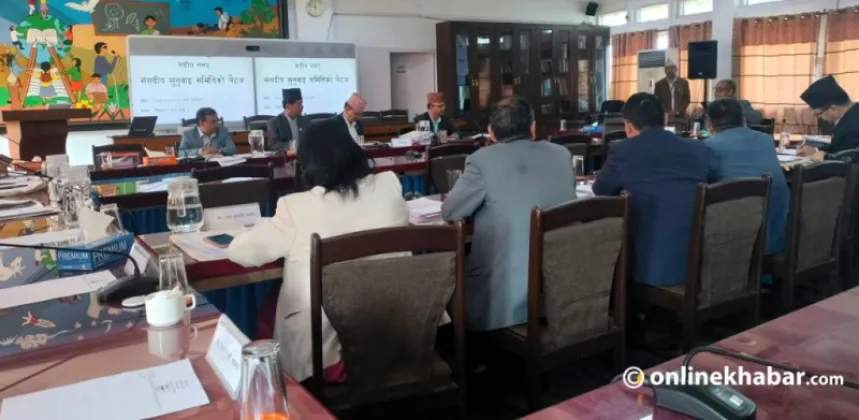
Chandrabahadur Saru, who has been proposed for appointment as a justice of the Supreme Court, told the Parliamentary Hearing Committee in Kathmandu on November 6 that clearing the country's oldest pending cases would be the central goal of his work plan. Presenting his plan at the hearing, Saru said he would reduce the number of cases pending for more than five years by 70 per cent within three years. He went further, stating that all 2,846 cases pending beyond the five-year mark would be cleared, with the settlement of the Supreme Court's long-pending cases treated as the first priority, as reported by OnlineKhabar.
A three-year deadline for five-year-old cases
The core of Saru's presentation was a pledge that is unusually specific for a judicial hearing. Rather than offering general assurances about efficiency or integrity, the nominee put forward a measurable commitment with a fixed deadline and a clearly defined universe of cases: those that have already waited more than five years for a decision. According to his plan, the commitments are:
- Reduce the number of cases pending for more than five years by 70 per cent within three years.
- Clear all 2,846 cases that have remained pending beyond the five-year mark.
- Give first priority to the settlement of the Supreme Court's long-pending cases.
Specificity of this kind cuts both ways. It gives the committee, the legal community and the public a clear standard against which the nominee can later be judged. It also means that if the number of five-year-old cases has not fallen sharply by the end of the stated period, the gap between promise and performance will be plainly visible. By putting the figure of 2,846 on the record at the hearing, Saru has effectively invited that scrutiny.
The hearing that tests a nominee's priorities
Before a proposed judge can take office, the nominee must face the Parliamentary Hearing Committee, the parliamentary body that examines people proposed for senior judicial and constitutional positions. The appearance in Kathmandu on November 6 was part of that process, and it offered the committee a structured look at how Saru views the challenges before the country's highest court.
Work plans presented at such hearings serve a purpose beyond ceremony. They signal what a nominee considers urgent once on the bench, whether that is case management, coordination with the lower courts or, as in Saru's case, the disposal of aged files. For members of the committee, such presentations provide a basis for questioning that goes beyond biography and professional record. For the public, they create a written record of promises that can be revisited long after the hearing has ended. Saru's decision to anchor his plan in a single, stark statistic, the 2,846 cases pending over five years, made that record unusually concrete.
Why five-year-old cases matter
The human cost of delay
Cases that remain pending for more than five years represent the sharpest edge of judicial delay. For the litigants involved, the wait is not an abstraction. Evidence ages, witnesses' memories fade, and the costs of pursuing a case accumulate year after year. Some parties to a dispute filed half a decade ago may no longer be in a position to pursue it themselves, leaving their families to inherit both the conflict and the delay.
The stakes are higher still when the pending cases sit at the Supreme Court. As the apex court, it is the final point of appeal in the justice system, and its rulings settle questions for everyone below. A case that lingers there leaves the parties in prolonged uncertainty, and it can leave the law itself unclear for lower courts and for citizens awaiting a definitive answer.
The difficulty of clearing old files
Clearing such a backlog is widely understood to be difficult. Older cases often involve voluminous records, multiple parties and complicated questions that have resisted quick resolution, which is precisely why they have survived this long while newer cases moved ahead of them. Turning a 70 per cent reduction into reality within three years would require that these files be systematically prioritised on the court's schedules rather than handled only as workload permits. That is the organisational burden Saru's plan implicitly accepts, and it is the measure by which his commitment will most naturally be tested.
From pledge to performance
Saru's appearance before the committee was one step in the process that determines whether he takes office as a Supreme Court justice. Whatever the committee's conclusion, his November 6 presentation now stands as a public benchmark. If he is confirmed and appointed, the three-year clock on his commitment to clear 2,846 long-pending cases begins to matter, and the courts' own records will show whether the number of aged cases falls at the pace he has promised.
For now, the pledge itself is the news. A nominee for the country's highest court has told the body weighing his appointment exactly what he intends to do about one of the most visible signs of delay in the justice system, and he has attached both a number and a deadline to it. Whether that target is met will depend on the months of work that follow the hearing. But for the parties to the cases in question, the plan offers something they have rarely been given: a date by which they have been told to expect resolution.