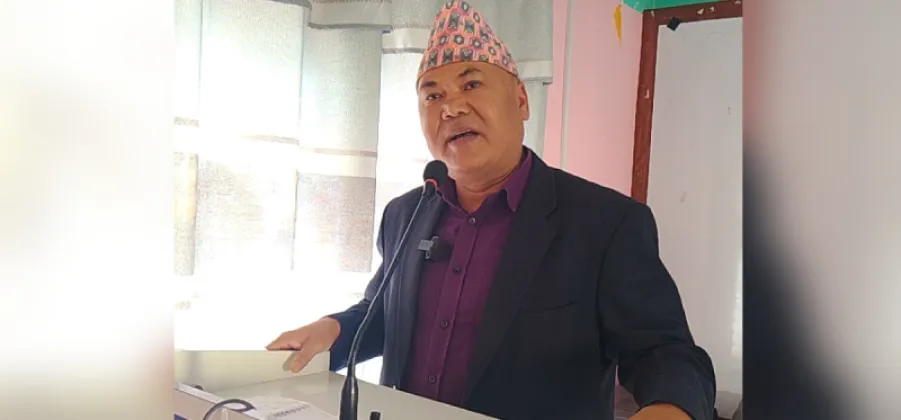
Kathmandu - A senior leader of the Nepali Congress on Friday accused the state of waging a deliberate campaign against his party, saying the offensive is designed to destroy democracy in Nepal. Yogendra Choudhary, the party's joint general secretary, said the financial transaction allegations leveled against party president Gagan Kumar Thapa are false and form part of a broader attempt to weaken the organisation, according to reports published by Nepali media outlets including Nagarik News, Ratopati and Nepal Press.
Choudhary's remarks place the dispute over the allegations against Thapa within a much larger claim: that the Congress is being targeted by the state itself. In his telling, an attack on the party and an attack on the democratic system cannot be separated, and he urged that the recent allegations be read in exactly that light.
'Attack on Congress is intended to end democracy'
According to the reports, Choudhary said the state side is carrying out a planned attack on the Nepali Congress with the intent of destroying democracy. The headline framing used by both Nagarik News and Ratopati captured the core of his message: the attack on the Congress, he said, is intended to end democracy.
He went further, arguing that efforts to weaken the party should not be dismissed as routine political friction. Instead, he said, they amount to a wrong conspiracy whose ultimate objective is to erode democracy. In Choudhary's framing, damage done to the Congress is damage done to the democratic order, and the two must be understood together.
Summarising his key points as reported on Friday:
- The state side is conducting a planned attack on the Nepali Congress.
- The intent of that attack, in his words, is the destruction of democracy.
- The financial transaction allegations against Thapa are false.
- Those allegations are an attempt to weaken the party.
- Weakening the Congress should be understood as a wrong conspiracy to erode democracy.
Allegations against Thapa dismissed as false
At the centre of Choudhary's intervention are the financial transaction allegations leveled against Thapa. Choudhary did not treat the claims as a genuine accountability question. He described them as false, and said their purpose is not to uncover wrongdoing but to weaken the Congress as an institution.
By dismissing the allegations outright, the joint general secretary signalled that the party intends to defend its president rather than engage with the claims on their substance. According to the reports, he framed the allegations as one instrument within the broader state-led attack he described, not as an isolated matter concerning a single individual. The reports of his remarks did not include further detail on the transactions in question, nor any response from the state side to his characterisation of the allegations.
A message aimed at party ranks and the public
Choudhary's comments were carried on Friday by multiple Nepali outlets, indicating that his characterisation of events travelled widely across the country's media. As joint general secretary, he speaks from within the party's senior leadership, and his remarks effectively lay out a public line of defence for the Congress at a moment when its president faces claims he insists are baseless.
The decision to frame the allegations as part of a state-led conspiracy is significant. Rather than allowing the financial transaction claims against Thapa to be debated as a discrete controversy, Choudhary elevated them into a question about the survival of democracy itself. That framing asks party members, allies and the public to judge the allegations not on their own terms, but in the context of what he described as a planned attack on the party.
The message also carries a mobilising purpose. By telling supporters that the Congress and democracy stand or fall together, Choudhary is urging the party's ranks to close around Thapa and around the organisation at a time of external pressure. Whether that framing persuades those outside the party is a question his remarks leave open.
What was said, and what was not
What is clear from Friday's coverage is the substance of Choudhary's charge: the state side, he said, is attacking the Congress deliberately, with the destruction of democracy as its goal, and the allegations against Thapa are a false element of that campaign. His words were reported consistently across the outlets that carried them, from the claim of a planned attack to the description of a conspiracy against democracy.
What the reports do not establish is anything independent about the allegations themselves. Choudhary's statement addresses their intent and their falsity as he sees it, but the available reports do not recount the underlying transactions or present evidence from either side. Nor do they include any reaction to his remarks.
For now, Choudhary's message stands as the senior leadership's public response: the Congress, in his account, is under attack, the attack is political, and its true target is not one leader but the democratic system the party claims to defend.