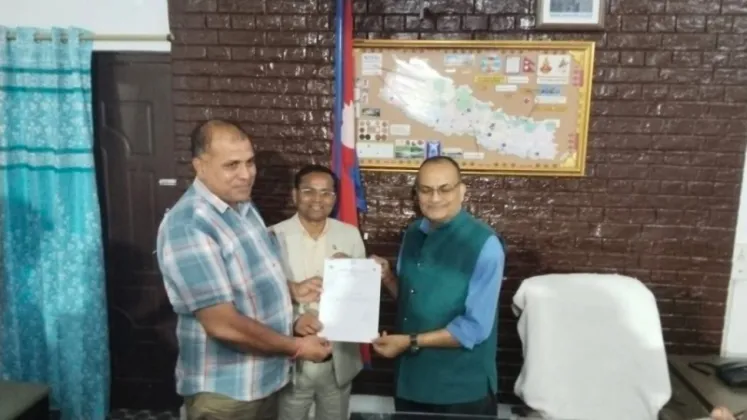
The Nepal Communist Party (NCP), known in Nepali politics as Nekpa, has formally exited the Congress-led provincial government in Madhesh, with four of its ministers submitting their resignations to Province Head Dr. Surendra Labh on Friday. The withdrawal was set in motion by the party's provincial parliamentary party, which decided at a virtual meeting to abandon the ruling coalition, and it was executed the same day when the party's ministers handed in their papers. The move is the second major rupture to strike the government of Chief Minister Yadav in a short span, following the earlier departure of the UML, and it pushes an already embattled administration deeper into crisis even as efforts continue to build a new power equation in the province.
A Virtual Meeting Seals the Exit
The end of the NCP's partnership in the Madhesh government began, fittingly for the times, on a screen rather than in a meeting hall. The party's parliamentary wing in the province convened a virtual meeting, weighed its position within the coalition, and concluded that the time had come to leave the government, as reported by Nepal Press.
What followed was swift and coordinated. Acting on the meeting's verdict, the party's four ministers moved to formalize the exit by tendering their resignations to Province Head Dr. Surendra Labh on Friday, converting an internal party decision into an official act of withdrawal from the Council of Ministers.
The sequencing matters politically. By holding the parliamentary party meeting first and resigning immediately afterward, the NCP has left little ambiguity about its intent, signaling to allies and rivals alike that its departure is a considered choice rather than a momentary protest.
Four Ministers Walk Out of the Cabinet
The NCP's exit does not merely end a partnership on paper; it removes sitting ministers from the provincial administration. The four members of the Council of Ministers who resigned include two of the government's most prominent faces:
- Yubaraj Bhattarai, Minister for Finance
- Kanis Patel, Minister for Industry and Tourism
The other two ministers who stepped down alongside them are also from the NCP, completing the party's withdrawal from the cabinet it had joined as part of the ruling alliance.
The loss of the finance minister in particular is a significant blow for any administration, given the portfolio's control over the province's budgetary machinery. Industry and tourism, the portfolio held by Patel, are similarly central to Madhesh's development agenda, and their departure deprives the government of continuity in two key economic ministries at a single stroke.
For Chief Minister Yadav, the resignations are both numerical and reputational. The spectacle of four ministers resigning on the same day underscores how quickly the coalition's foundations have eroded, and how difficult it has become for the government to hold its partners together.
The Second Blow After the UML Exit
The NCP's walkout follows an earlier and equally consequential development: the departure of the UML from the Madhesh government. That exit had already weakened the Congress-led administration of Chief Minister Yadav, and the loss of the NCP within a short span now amounts to a second, compounding shock.
Provincial media have framed the sequence bluntly. Pradesh Khabar reported the resignations as the latest turn in the government's troubles, while Nepal Press captured the drama in its headline: after the UML in Madhesh, the NCP has also left the Madhesh government, leaving Chief Minister Yadav in crisis.
The pattern is a familiar one in coalition politics, but its pace is what stands out. A government that loses a single partner can often survive through negotiation and reshuffles. Two departures in quick succession, however, turn a coalition's troubles from a management problem into an existential one, and that is precisely the situation in which Chief Minister Yadav's government now finds itself.
The Push for a New Power Equation
The NCP's exit does not occur in a vacuum. It comes amid ongoing efforts to assemble a new power equation in Madhesh, and the resignation of the party's ministers is set to feed directly into those maneuverings. The question now occupying the province's politics is what the next arrangement will look like, and who will be part of it.
What Comes Next
For the Congress-led government, the immediate challenge is survival. Having lost the UML and now the NCP, Chief Minister Yadav's administration has been pushed, as reports put it, further into crisis, with its ability to command the provincial assembly under fresh scrutiny. The government must now either find a way to stabilize its position or watch as opponents translate the momentum of these resignations into an alternative governing arrangement.
The aftermath will be watched closely across the province. News of Nepal reported the resignations as they were submitted to Province Head Dr. Surendra Labh on Friday, and any response from the Chief Minister's camp or the departing party is expected to shape the next phase of Madhesh's politics. For now, one fact stands out clearly: a government that once rested on a multi-party coalition has seen two of its pillars walk away, and the contest to define what comes next has begun.