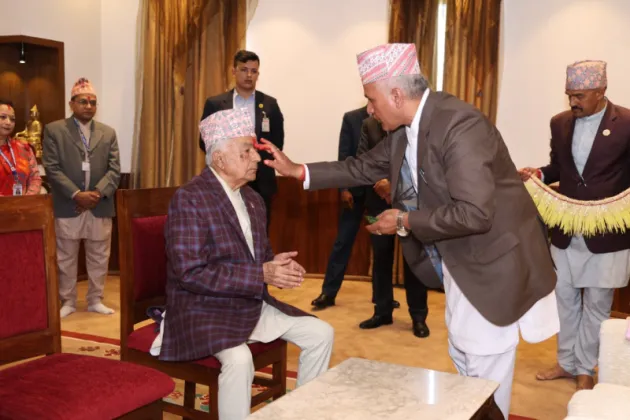
President Ram Chandra Paudel received the Vijaya Dashami tika and jamara at the auspicious time on October 21, 2026, as Nepal marked the main day of the Dashain festival. The tika and jamara were applied at the shubha saait, the auspicious moment designated for the principal ritual of the festival's tenth day, and the ceremony was reported by multiple Nepali news outlets as part of the annual Vijaya Dashami celebrations.
Tika and Jamara at the Shubha Saait
The President's observance centred on the shubha saait, the window of time regarded as most propitious for receiving tika on Vijaya Dashami. Timing carries particular weight in Dashain tradition, and the auspicious hour is traditionally determined through astrological calculation and announced in advance, with households across the country waiting for the appointed moment before elders apply tika and jamara to younger family members. By receiving the tika at the prescribed time, President Paudel joined the millions of Nepalis for whom the ritual anchors the most important day of the festival calendar.
News of the ceremony was carried by Nepal Lead and Nepal Views, which reported that the Head of State had received the tika and jamara at the auspicious time on the main day of Dashain. Their coverage placed the President's ritual within the broader annual Vijaya Dashami celebrations observed across the country.
The Ritual and Its Meaning
In Dashain tradition, the tika is a mixture of rice grains, red vermilion and yogurt applied to the forehead, while the jamara consists of tender barley shoots grown specially for the festival. Together they are bestowed by elders on younger relatives with blessings for health, prosperity and good fortune. The giving and receiving of tika and jamara does not end on the day of Vijaya Dashami itself; the exchange continues through the remaining days of the festival as relatives visit one another's homes.
The day carries profound religious symbolism as well. Vijaya Dashami commemorates the victory of the goddess Durga over the demon Mahishasura, a triumph of good over evil from which the festival takes its name. The jamara, sown days earlier and nurtured away from direct sunlight until it emerges pale and golden, is regarded as a bearer of prosperity and is worn in the hair or kept close through the festival period.
A Ritual Shared Across Generations
Beyond its religious meaning, the tika ceremony is the emotional heart of Dashain for many families. Members gather at ancestral homes, younger relatives bow before their elders, and blessings are exchanged alongside festive meals. The image of the President receiving tika and jamara at the auspicious hour thus mirrors a scene repeated in countless households across Nepal on the same day, underscoring how a single ritual binds the highest office in the country to the everyday life of its people.
Dashain: Nepal's Biggest Festival
Dashain is the largest festival in the Nepali calendar, observed over fifteen days that fall during the autumn season. It is a time when schools and offices close, cities gradually empty as people travel to their home towns and villages, and markets bustle with shoppers preparing new clothes, gifts and festive provisions. For many Nepalis, including the large diaspora living and working abroad, Dashain remains the one occasion in the year that reliably brings families back together.
Vijaya Dashami, the tenth day, stands as the climax of these celebrations. It is on this day that the tika and jamara, prepared and blessed through the preceding days of worship, are formally applied, and it is this ritual that gives the festival its most recognisable public face. The announcements of the shubha saait, the queues of relatives waiting to receive blessings, and the exchange of jamara all converge on this single day.
A National Tradition Observed at the Highest Level
The wide reporting of President Paudel receiving the tika underscores the place Dashain occupies in Nepal's national life. When the Head of State observes the shubha saait and accepts the tika and jamara, the act resonates well beyond the ceremony itself, reflecting how deeply the festival's traditions are woven into the identity of both the state and its people.
For President Paudel, as for the families celebrating across the country, the moment captured the essence of Vijaya Dashami: the renewal of blessings, the strengthening of bonds between generations, and the commemoration of the victory of good over evil at the heart of Nepal's most cherished festival.