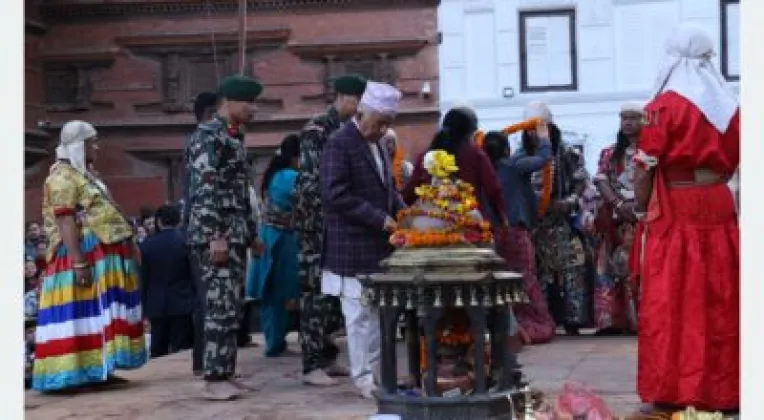
President Ramchandra Paudel on Saturday visited the historic Nasal Chowk Dabali at Hanumandhoka in Kathmandu to observe the traditional Devi Naach, or Goddess Dance, celebration. The President was accompanied by First Lady Sabita Paudel for the evening's cultural programme, held at one of the capital's most storied performance venues inside the old royal palace complex.
The performance was organised by the Naradevi Shree Shwetakali Conservation and Management Committee as part of the 12-year Devi Dance Festival, a celebration that brings the sacred dance tradition to the public stage in the heart of Kathmandu.
A President at the Dabali
The President's attendance underscored the significance the country's highest office continues to attach to Nepal's intangible cultural heritage. Nasal Chowk Dabali, located within the Hanumandhoka Durbar Square area, has historically served as the stage for royal and religious performances, making it a fitting setting for a ritual dance dedicated to the goddess.
President Paudel, along with the First Lady, joined the gathered audience at the Dabali to watch the Devi Naach, in which performers embody the goddess through dance and ritual movement. The presence of the head of state at such a traditional observance drew attention to the continuing efforts to preserve and promote the centuries-old performance tradition in the Kathmandu Valley.
The 12-Year Devi Dance Festival
The Devi Naach observed by the President was staged by the Naradevi Shree Shwetakali Conservation and Management Committee, the body responsible for the conservation and management of the Shwetakali shrine at Naradevi. The committee has been organising the performance as part of the broader 12-year Devi Dance Festival, a cycle that marks a special period for the goddess dance tradition.
Festivals of this kind, observed on long cycles, hold particular importance for Newar communities in Kathmandu, where ritual dances dedicated to deities are performed with strict traditional protocols. Bringing the Devi Naach to Nasal Chowk Dabali connects the living tradition with the very venue where such performances were historically patronised.
Preserving a Sacred Tradition
The Devi Naach is among the sacred masked and ritual dances of the Kathmandu Valley, in which dancers, following elaborate rituals, are believed to embody the goddess herself during the performance. Such dances are not merely artistic presentations but religious observances, involving specific rites, attire and musical accompaniment passed down through generations.
Organisations like the Naradevi Shree Shwetakali Conservation and Management Committee play a central role in ensuring that these traditions survive amid rapid urban change. Conservation committees around the valley work to maintain shrines, train performers and organise periodic festivals so that the ritual knowledge associated with dances like the Devi Naach is transmitted to younger generations.
The staging of the dance at Hanumandhoka, a UNESCO-recognised heritage site area, further highlights the deep ties between the valley's monuments and its living cultural practices. The palaces, courtyards and dabalis of the old city were built not only as residences and administrative spaces but as stages for the rituals that continue to define the cultural identity of Kathmandu.
High-Profile Support for Cultural Heritage
The visit by President Paudel and First Lady Sabita Paudel adds a notable endorsement to the ongoing festival. National-level attention to traditional performances helps raise public awareness of their cultural and religious value, encouraging broader participation and support for the committees that sustain them.
Observers of Nepal's cultural scene have long stressed that rituals such as the Devi Naach face challenges ranging from declining numbers of trained performers to the pressures of modernisation. Events that place the tradition at prominent public venues, attended by national leaders, serve as a reminder of the shared responsibility to safeguard this heritage.
As the 12-year Devi Dance Festival continues, Saturday's programme at Nasal Chowk Dabali stands as a highlight, combining the patronage of the country's highest office with the devotion of the community that has kept the goddess dance alive for generations.