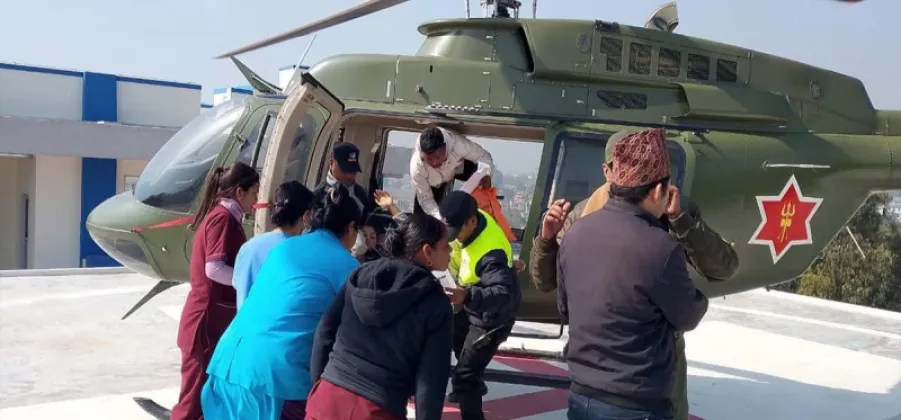
A 20-year-old woman from Budhinanda Municipality-1 in Bajura district was airlifted for emergency treatment after she developed complications during delivery, authorities confirmed. The rescue took place on Mangsir 9, when a Nepali Army aircraft flew the woman from the remote hilly district to the Karnali Province Hospital, where she is receiving further treatment.
The airlift was carried out under an air rescue program run by the Ministry of Women, Children, Gender and Sexual Minorities and Social Security as part of the National Women's Empowerment Project, which is designed to help women in remote districts access emergency health services that are otherwise difficult to reach.
Rescue operation under women's empowerment project
The woman, who was facing a complicated delivery, could not be treated locally given the limited medical facilities available in Budhinanda Municipality, one of the more remote areas of Bajura. With her condition deteriorating, authorities mobilized the air rescue mechanism coordinated by the Ministry of Women, Children, Gender and Sexual Minorities and Social Security.
A Nepali Army aircraft was deployed for the mission, landing to pick up the patient and flying her out of the district on Mangsir 9. She was transported directly to Karnali Province Hospital for advanced care. Further details about her medical condition have not been disclosed in reports from the district.
Why air rescues matter in districts like Bajura
Bajura, located in the Sudurpashchim Province, is among Nepal's remote hilly districts where road connectivity remains poor and health infrastructure is thin. Pregnant women facing delivery complications often cannot reach hospitals in time by land, making helicopter and fixed-wing rescues a lifeline in obstetric emergencies.
The air rescue program under the National Women's Empowerment Project was introduced precisely for such situations. It enables the state to airlift women facing medical emergencies, including complicated pregnancies, from districts where referral transport by road is impractical. The Ministry coordinates with security agencies, including the Nepali Army, to carry out these flights.
Institutional support and coordination
The rescue highlights the role of multiple agencies working together: the Ministry provided the program framework and funding through the National Women's Empowerment Project, while the Nepali Army supplied the aircraft and crew for the airlift. The receiving end, Karnali Province Hospital, serves as a major referral center for patients from remote districts of the mid- and far-western hills.
Women's rights and health advocates have long pointed to maternal health emergencies as one of the starkest examples of geographic inequality in Nepal, where a woman's access to emergency obstetric care can depend heavily on which district she lives in. Programs like this air rescue scheme are aimed at narrowing that gap, at least for the most critical cases.
What happens next
The woman remains under treatment at Karnali Province Hospital, where doctors will manage her delivery complications. No updates on her condition were available at the time of reporting.
The incident serves as another reminder of the importance of emergency referral mechanisms for pregnant women in remote Karnali and Sudurpashchim hill districts. Authorities in Bajura have urged pregnant women and their families to make use of institutional delivery services and to contact local authorities early when complications arise, so that rescue arrangements can be made without delay.
Source: Nagarik News and Rajdhani Daily