Airlift from Remote Dolpa
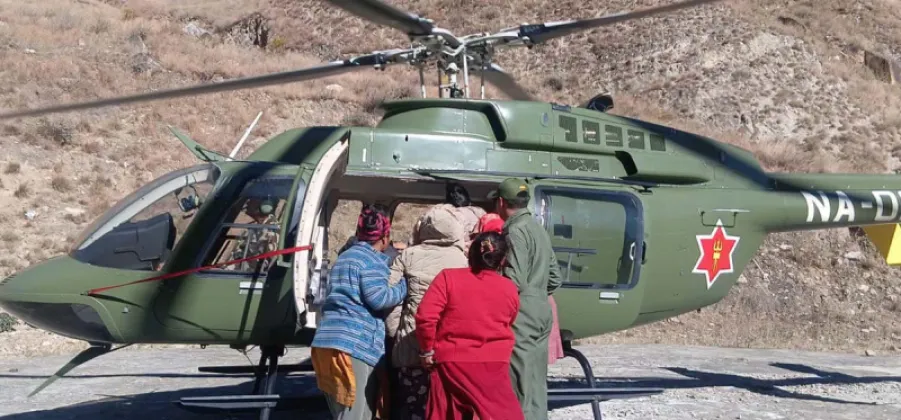
The operation was carried out through the Ministry of Women, Children, Senior Citizens, Gender and Sexual Minorities and Social Security's air rescue programme, which falls under the National Women's Empowerment Project. The programme exists specifically to help pregnant women in remote areas of the country reach life-saving care when local health facilities cannot manage complications.
Dolpa, one of Nepal's most remote high-altitude districts, lacks adequate road connectivity and specialised maternal health services, making air evacuation one of the few viable options in emergencies like this one. The use of a Nepal Army aircraft reflects the government's reliance on the army's air wing to reach far-flung settlements that private operators often cannot or do not serve.
A Programme for Remote Mothers
The National Women's Empowerment Project's air rescue initiative has become a critical lifeline for expectant mothers in districts where pregnancy and childbirth remain dangerous undertakings. Women in remote Karnali districts frequently face hours or even days of travel to reach facilities equipped to handle obstetric emergencies, and delays in reaching care are a known contributor to maternal deaths in Nepal.
- The programme targets pregnant women facing complications in remote areas
- Rescue operations are coordinated by the federal ministry with support from security agencies
- Karnali Provincial Hospital serves as a key referral centre for the province
The airlifted woman is now receiving treatment at Karnali Provincial Hospital, the main referral facility for the province. Details of her condition following the rescue were not immediately available, but her transfer marks the continuation of what has become a recurring emergency intervention for women from Dolpa and neighbouring high Himalayan districts.
Persistent Gaps in Maternal Care
While air rescues like this one save individual lives, health advocates in Karnali have long pointed out that they also underscore the region's deep healthcare gaps. Basic obstetric services remain out of reach for many villages in Dolpa, where geography, sparse population and harsh winters make staffing and equipping local facilities difficult. Emergency transport by air is often the difference between life and death for women who develop complications far from an operating theatre.
The rescue on Mangsir 9 adds to a series of similar evacuations conducted under the programme in recent years. Officials have said the initiative is designed to ensure that poverty and isolation do not prevent pregnant women from accessing emergency medical care, with the government bearing the cost of the flights.
For the family of the 23-year-old from Tripurasundari Municipality-9, the swift mobilisation of a Nepal Army aircraft on Mangsir 9 provided a path to specialised care that would otherwise have been nearly impossible to reach. Her airlift stands as another example of how the air rescue programme continues to function as a safety net for mothers in Nepal's most remote corners, even as the underlying need for better local maternal health infrastructure persists.