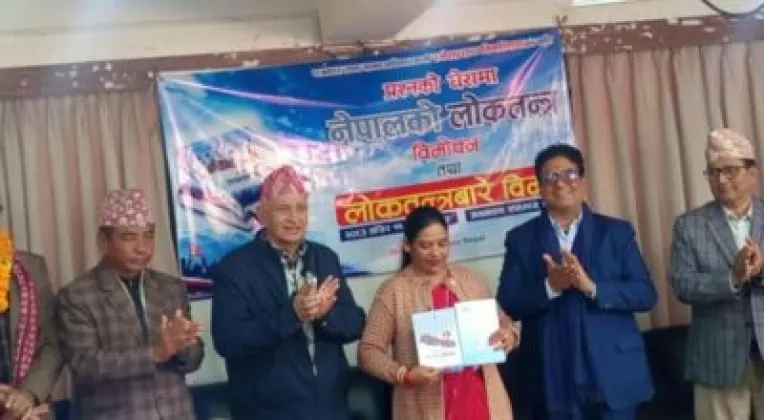
The book Prashnako Gherama Nepal Ko Loktantra, which raises questions about Nepal’s democratic practice and related issues including citizens’ rights, human rights, good governance and public accountability, was launched on Friday at Janabhawana Campus in Chapagaun, Lalitpur. The programme was jointly organised by news organisation Mass Nepal and the Godavari Sahitya Parishad, with senior journalist Prof. Purushottam Dahal and others releasing the book. A debate on different aspects of democracy was also held during the event.
Book puts democratic practice under scrutiny
The book’s title translates as “Nepal’s Democracy in the Circle of Questions,” reflecting its focus on questions surrounding how democracy is practised and experienced in the country. Its stated areas of concern extend beyond democratic practice to include the rights of citizens, human rights, good governance and accountability in public life.
The launch brought the book into public view through a programme combining its release with discussion. The topics identified around the publication span both the principles of democracy and issues tied to the conduct of public institutions. The event’s debate provided a forum to consider several aspects of democracy, though no specific conclusions or resolutions from the discussion were reported.
Joint programme in Chapagaun
Mass Nepal and the Godavari Sahitya Parishad jointly organised the event at Janabhawana Campus in Chapagaun, Lalitpur. Prof. Dahal, a senior journalist, released the book alongside others. The organisers brought the publication launch and the democracy debate together in a single programme.
The event’s location in Chapagaun made the campus the venue for both the book’s public release and the accompanying discussion. The programme focused on democracy as a subject for debate, with the book’s stated concerns providing a frame for examining citizens’ rights, human rights, governance and accountability.
Discussion broadens the launch beyond the book
A debate on various aspects of democracy was part of the programme, making the event more than a formal release. The discussion addressed democracy as a subject requiring examination, in keeping with the questions raised by the book’s focus. No details were provided about individual speakers, the specific arguments made or the outcome of the debate.
The issues highlighted around the book connect democratic practice with the rights of citizens and with expectations of good governance and public accountability. These themes were presented as areas the publication questions, rather than as findings or conclusions attributed to it. The launch and debate therefore centred on opening these subjects for consideration, without details about particular chapters or the book’s author available in the information provided.
By pairing the release with a public debate, Mass Nepal and the Godavari Sahitya Parishad placed the publication within a broader conversation about democracy in Nepal. The Friday programme at Janabhawana Campus brought together the book’s questions and a discussion of democratic issues, while the release by Prof. Dahal and others formally marked its launch in Lalitpur.