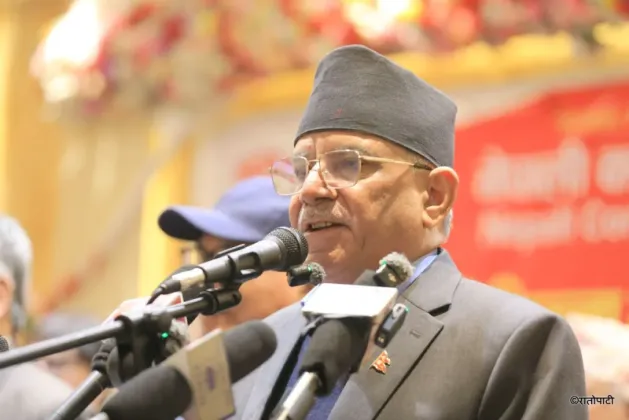
KATHMANDU - Former Prime Minister and Nepal Communist Party coordinator Pushpa Kamal Dahal 'Prachanda' has described Prime Minister Balendra (Balen) Shah's recent visit to India as a normal and routine trip, suggesting it should not be viewed as an exceptional diplomatic event. His remarks, reported by Nepali media outlets on November 26, 2026, come as public and political attention continues to focus on the new Prime Minister's engagement with Nepal's southern neighbour.
Speaking about the visit, Prachanda characterized it as ordinary rather than extraordinary, framing it within the regular rhythm of Nepal-India relations rather than as a landmark moment in the country's foreign policy.
A measured assessment from a political rival
Prachanda's comments carry particular weight given his long career at the centre of Nepali politics. As a former Prime Minister himself, and as someone who has visited India in an official capacity on multiple occasions, his assessment of the trip drew immediate interest from observers of Kathmandu's political scene.
According to one Nepali outlet, Prachanda went so far as to draw a comparison between Prime Minister Shah's visit and his own past engagements with India, remarking that Balen's visit to India "was not as good as mine." The remark suggests that while Prachanda was careful to describe the trip as normal and routine, he did not shy away from measuring it against his own diplomatic record, injecting a note of political rivalry into his otherwise measured commentary.
The comments were made public on November 26, 2026, with both Rastriya Samachar-affiliated portal Ratopati and Nepal Press carrying reports on the former Prime Minister's statements. Ratopati's headline summarized his position directly: "PM Shah's visit to India normal and regular: Prachanda."
Context of the India visit
Nepal and India share an unusually close and complex relationship, shaped by an open border, deep people-to-people ties, extensive trade links and long-standing cooperation on water resources, energy and connectivity. Visits by Nepali Prime Ministers to New Delhi are a well-established feature of this relationship, and every head of government in Kathmandu has traditionally made India among their first diplomatic stops after taking office.
It is against this backdrop that Prachanda's characterization of the trip as "normal and routine" is best understood. By describing the visit in these terms, the former Prime Minister appears to be tempering any narrative that might present it as a dramatic shift or a uniquely successful diplomatic overture. At the same time, his remarks implicitly acknowledge that such visits are part of the standard architecture of Nepal-India relations, regardless of who occupies the Prime Minister's office in Kathmandu.
For a new Prime Minister, the first visit to India is often closely watched at home. Critics in Nepal frequently scrutinize such trips for signs of whether the government is asserting Nepali interests on matters such as the border, trade imbalance and hydropower, while supporters point to the practical importance of maintaining smooth ties with New Delhi. Prachanda's framing of the visit as routine places him in the camp of those who see it as business as usual rather than a breakthrough.
Political undertones of the comparison
The most striking element of Prachanda's comments, as reported by Nepal Press, is the personal comparison he drew with his own record. The remark that Balen's visit "was not as good as mine" reflects the competitive dynamic that has come to define relations between the former Maoist leader and the current Prime Minister.
Prachanda, who led the Maoist insurgency before entering mainstream politics and later served as Prime Minister multiple times, has extensive experience of high-level diplomacy with India and China. His decision to both downplay the significance of Shah's visit and simultaneously claim superiority for his own diplomatic engagements captures the dual message he appears to be sending: that the trip deserves no special praise, and that his own track record remains the benchmark.
A reminder of continuity in Nepal's foreign policy
Beyond the political sparring, the exchange underscores a recurring theme in Nepali politics: foreign policy, and relations with India in particular, tends to draw intense commentary from across the political spectrum whenever a government engages with New Delhi. Former Prime Ministers and senior party leaders routinely weigh in on such visits, offering assessments that blend substantive critique with domestic political positioning.
Prachanda's remarks on November 26, 2026, fit squarely within that tradition. By calling Prime Minister Shah's visit to India normal and routine, he has signalled that, in his view, the trip should be judged against the standard expectations of Nepal-India diplomacy rather than celebrated as an extraordinary achievement. Whether his comparison with his own visits sparks further debate within the ruling establishment and the opposition remains to be seen.
For now, the comments offer one of the first high-profile political reactions to Prime Minister Balen Shah's engagement with India, and they set a measured, if competitive, tone for how the visit is likely to be discussed in Kathmandu's political circles in the days ahead.
Sources: Ratopati, Nepal Press