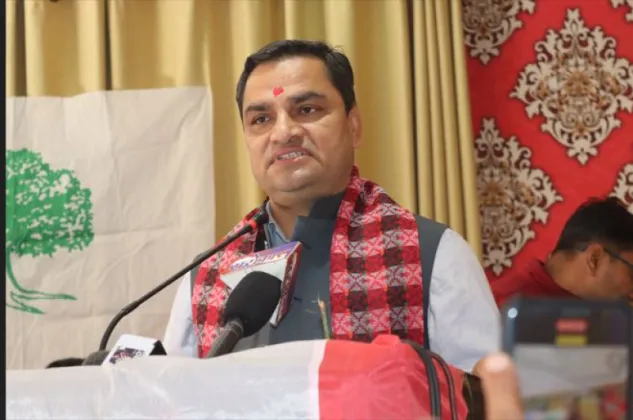
Kathmandu, November 28 - Nepali Congress General Secretary Pradeep Poudel on Saturday directly questioned Prime Minister Balen Shah's government over allegations that a person held in jail was threatened into giving a statement, asking whether the country was actually being governed or whether "gundaraj", or rule by gangsters, was in operation. Addressing a program organized by the Nepali Congress Kathmandu Constituency No. 6, Poudel also raised the issue of the misuse of state power during the eight months since the government was formed, turning an alleged abuse inside the prison system into a sweeping indictment of the administration's conduct.
'Government or gundaraj?' - Poudel's blunt challenge
According to a report by Nepal Press, Poudel used the constituency-level program of his party to put the question to the Prime Minister in the starkest possible terms: is the government actually being run, or is "gundaraj" being run instead? The phrase, common in Nepali political discourse, evokes rule by intimidation, coercion and lawlessness rather than by the constitution, and its use by a senior office-bearer of the Nepali Congress signals how sharply the party intends to frame its criticism of the Shah-led government.
The General Secretary's remarks were not presented as a routine policy disagreement. By pairing the alleged jail incident with the question of whether a government or a gangster rule is functioning, Poudel sought to place the controversy at the level of the state's basic character. His core criticisms, as reported, can be summed up as follows:
- Allegations that a person held in jail was threatened in order to extract a statement
- The question of whether a legitimate government or "gundaraj" is in operation
- Concerns about the misuse of state power over the eight months since the government was formed
Together, these points mark one of the most pointed opposition challenges to the government's governance record to emerge from the party's organizational platform in the capital.
The alleged jail threat at the center of the row
The immediate trigger for Poudel's intervention is the allegation that a person in custody was threatened so that a statement could be obtained. Details of the alleged incident were not elaborated in the report, but the charge itself carries serious implications. In any democracy, statements made by a detained person are expected to be voluntary and free from coercion; if threats are used to produce them, both the rights of the individual and the integrity of any proceeding that relies on such a statement are called into question.
Why the allegation strikes at the rule of law
This is the concern that underlies Poudel's rhetoric. An abuse of this nature, if it involves organs of the state, would suggest that the machinery of law enforcement is being directed not at upholding the law but at producing predetermined outcomes. That is precisely the gap between a government and the "gundaraj" that Poudel invoked. By raising the matter at a public party program rather than confining it to internal discussion, the Nepali Congress leadership has ensured that the allegation will remain in the political arena, where the government will be pressed to clarify what happened and who, if anyone, was responsible.
Eight months of alleged misuse of state power
Poudel did not limit his criticism to a single incident. According to the report, he also raised questions about the misuse of state power in the eight months since the Balen Shah government was formed. In Nepali political debate, such misuse typically refers to the deployment of the administration, security agencies and legal processes for ends that serve those in power rather than the public. By tying this broader charge to the alleged jail threat, Poudel presented the incident not as an isolated lapse but as part of a pattern that, in his assessment, has run through the government's tenure so far.
The eight-month mark is also a meaningful vantage point. It is long enough for a government's working style to become visible, and short enough that any deterioration in standards registers as a departure from the promises made when it took office. Poudel's framing invited the audience to judge the government against exactly that yardstick.
Political stakes for the Congress and the government
The venue of the remarks carries its own significance. The program was organized by the Nepali Congress's Kathmandu Constituency No. 6, a party forum in the heart of the capital, and the message was therefore aimed as much at the party's own cadres and the wider public as at the government. For a General Secretary of the party to devote his address to the alleged coercion of a prisoner and the character of the government suggests that the Nepali Congress intends to keep governance and the rule of law at the center of its opposition politics.
For the Shah government, the criticism lands at a sensitive moment in its eight-month tenure. An allegation that a person in jail was threatened to give a statement is the kind of charge that demands a clear public accounting, both because of what it says about the treatment of people in custody and because it feeds the larger opposition narrative that state power is being misused. The Nepal Press report did not carry an immediate response from the government or the Prime Minister's side to Poudel's questions.
Until such a response comes, Poudel's question, whether a government is being run or "gundaraj", is likely to remain the framing through which the Nepali Congress and other critics measure this administration's conduct in the weeks ahead.