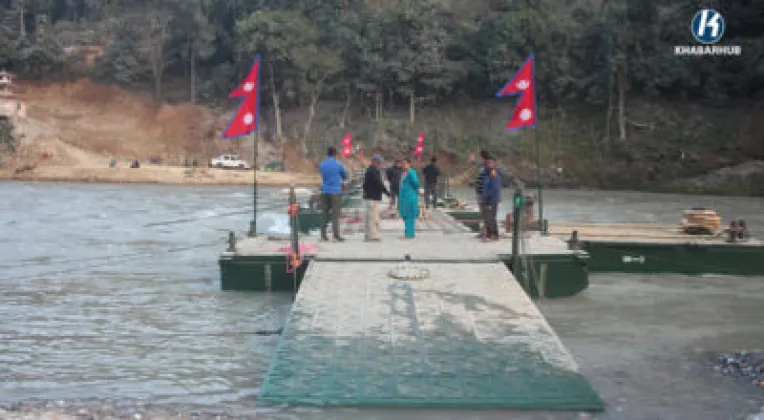
A temporary pontoon bridge has been installed over the Furke Khola of the Trishuli River at the border of Gajuri Rural Municipality-2 and Siddhalek Rural Municipality-6 in Dhading district, restoring a vital crossing severed by recent flooding. The bridge was brought from Kothiaghat in Bardiya and completed on Sunday through the joint initiative and shared cost of all 13 local levels of the district.
The installation follows devastating floods that swept away the permanent Furke Khola bridge. Floodwater that came through the Bhote Koshi into the Trishuli River had washed away the structure, cutting off Dhading Besi and eight local levels of the northern part of the district from the national highway network. The loss of the crossing had left residents of these areas struggling to reach the district headquarters and the rest of the country.
A District-Wide Effort
The pontoon bridge was not the work of a single authority. All 13 local levels of Dhading joined hands to bring the bridge from Kothiaghat in Bardiya, sharing the cost among themselves. This district-wide cooperation allowed the temporary structure to be completed on Sunday, providing immediate relief to thousands of people who had been dependent on alternative and difficult routes.
The bridge has been installed at the point between Gajuri Rural Municipality-2 and Siddhalek Rural Municipality-6, replacing the swept-away permanent bridge at the Furke Khola crossing over the Trishuli River. Photos of the installation published by local media show the pontoon structure being placed across the river to reconnect the severed link.
Relief for Eight Local Levels
The reconnection brings relief primarily to the eight local levels of northern Dhading that had been cut off from the national highway after the flood. With the permanent bridge gone, movement of people, goods, and vehicles between these areas and Dhading Besi had been severely disrupted.
The temporary pontoon bridge now serves as the key crossing point over the Trishuli at Furke Khola, allowing residents to resume travel to and from the district headquarters. The restoration of the crossing is expected to ease the movement of daily supplies and enable normal life to gradually return in the affected northern areas.
Flood Damage Background
The destruction of the Furke Khola bridge was caused by flooding that originated through the Bhote Koshi and flowed into the Trishuli River. The floodwaters swept away the permanent bridge, which had served as the main connection between Dhading Besi and the northern local levels with the national highway.
In the aftermath of the disaster, the district faced an urgent need for an alternative crossing. The response came in the form of the pontoon bridge from Bardiya, transported to Dhading and installed at the same point where the permanent structure once stood.
While the pontoon bridge is a temporary solution, its completion on Sunday marks a significant step in restoring connectivity in Dhading after the flood damage. The joint funding model adopted by the district's 13 local levels demonstrates a coordinated local response to the infrastructure loss.
Path Ahead
With the pontoon bridge now in place over the Furke Khola, residents of Gajuri, Siddhalek, and the seven other affected local levels can once again cross the Trishuli River to reach the national highway. The structure stands in for the permanent bridge until a more durable solution is put in place.
The initiative, completed through shared effort and resources from across the district, has been described in local media reports as a source of relief for the people of northern Dhading who had endured days of isolation following the flood.