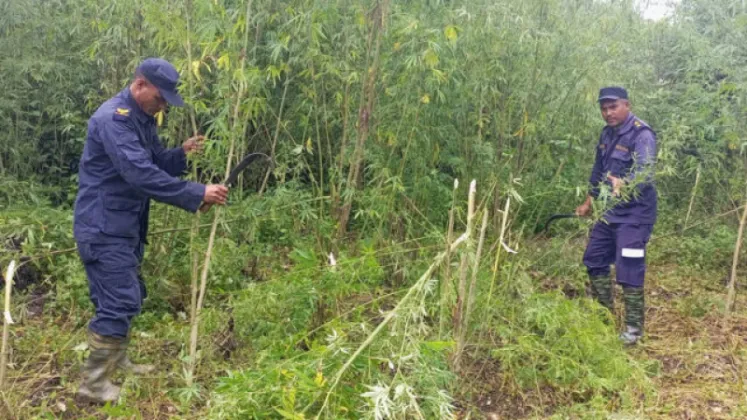
Police have destroyed illegal marijuana plantations spread over eight bigha and five kattha of land across three districts of Bagmati Province in an intensified crackdown on narcotics cultivation.
According to Rajendra Prasad Dhamala, spokesperson for the Bagmati Province Police Office, the destroyed plantations covered land in Makwanpur, Dhading and Sindhuli districts. The operation was carried out between November as part of an ongoing campaign against the illegal cultivation of cannabis in the province.
District-wise breakdown of the operation
Of the total land cleared, the largest share was in Makwanpur district, where police destroyed marijuana grown on five bigha of land. In Dhading district, plantations spread across two bigha and 12 kattha were cleared, while in Sindhuli district, police destroyed cannabis cultivated on 13 kattha of land.
A bigha, widely used as a unit of land measurement in the Terai and inner regions of Nepal, is equivalent to roughly 13.3 ropani, with one bigha comprising 20 kattha. Taken together, the eight bigha and five kattha of destroyed plantations represent a substantial area of illicit cultivation removed from the three districts in a single sustained phase of the campaign.
Part of a wider anti-narcotics campaign
The destruction drive falls under the intensified campaign being run by the Nepal Police against narcotics cultivation, trafficking and abuse. Spokesperson Dhamala said the operation was conducted between November as police moved against fields where marijuana had been illegally planted across the province.
Bagmati Province, which surrounds the federal capital and includes districts with remote hill areas such as Makwanpur, Dhading and Sindhuli, has in recent years seen repeated police action against cannabis fields hidden in forested and less accessible terrain. Such operations typically target growers who cultivate the crop for sale into illegal drug supply chains.
Continued enforcement urged
The Bagmati Province Police Office has indicated that the campaign against narcotics cultivation will continue, with security personnel monitoring areas prone to illegal planting. Authorities have repeatedly called on local governments, community members and farmers to cooperate in identifying and reporting marijuana fields in their vicinities.
Police officials say that destroying standing plantations before harvest is a key strategy, since it cuts off the supply of cannabis at its source and disrupts the networks involved in its trade. The provincial police office is expected to continue such destruction drives across affected districts as part of the broader national effort to make Nepal free of illegal drug cultivation.
Further details on arrests, if any, linked to the destroyed plantations in Makwanpur, Dhading and Sindhuli have not yet been made public. The operation, however, stands as one of the larger recent anti-narcotics actions in the province in terms of the total land area cleared.