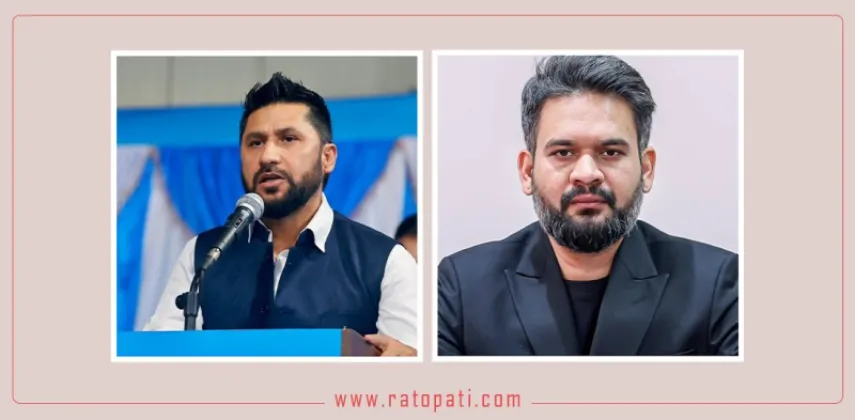
Prime Minister Balendra Shah has responded to Rastriya Swatantra Party (RSP) chairman Rabi Lamichhane after the party chief questioned the government's decision to remove Inspector General of Police (IGP) Dan Bahadur Karki, publishing his reply on Facebook on Thursday night. The exchange, which unfolded in full public view in Kathmandu, has turned the removal of the head of the Nepal Police into the latest flashpoint between the government and one of the country's most prominent political figures.
Lamichhane's challenge to the government
The confrontation began when Lamichhane, chairman of the Rastriya Swatantra Party, directly questioned the government's move to remove IGP Dan Bahadur Karki from the country's top police post. As Ratopati reported, he asked the government to justify the IGP change, effectively demanding a public explanation for the removal of the senior-most official in the Nepal Police.
The demand placed the ball firmly in the government's court. When the answer came, it did not arrive through a formal statement or an official briefing, but from the Prime Minister himself, in a personal Facebook post. Khabarhub noted that Shah issued his response on Thursday night, a short and pointed reply to the question Lamichhane had raised over the government's decision.
Shah's reply: saving the country versus saving a party
In his post, Prime Minister Shah drew a sharp distinction, saying there is a difference between saving the country and saving a party. The phrasing, carried by Ratopati and Pradesh Khabar, delivered a pointed political message in response to the RSP chairman's demand for justification.
Beyond defending the government's decision, the remark carried a second, more provocative layer. According to the reports, the comment suggested divisions within the RSP leadership itself, implying that the party's internal position may not be as unified as its public posture on the IGP question. By framing the debate as one of national interest versus partisan interest, the Prime Minister sought to reframe the argument on his own terms, casting the RSP's objection as politically motivated rather than a matter of legitimate scrutiny.
For Lamichhane, the reply shifted the ground of the debate. His question had been procedural in nature, pressing the government to explain the removal of the police chief. The response he received instead addressed the motive behind the question, setting up a clash that is as much about political messaging as it is about the police leadership.
The stakes behind an IGP change
The Inspector General of Police heads the Nepal Police, the country's principal law enforcement agency, and a decision to remove the IGP is among the most consequential personnel calls a government can make in the security sector. It is precisely the weight of such a decision that Lamichhane sought to highlight by demanding that the government justify the change at the top of the force.
What the available reports do not include is the government's detailed reasoning. Neither the accounts of Shah's Facebook post nor the reporting on Lamichhane's statement detail the specific grounds for removing IGP Karki. That leaves the central question the RSP chairman raised, the question of justification, formally unanswered in the public domain, even as the political argument around it intensifies.
The exchange at a glance
- Who: Prime Minister Balendra Shah and Rastriya Swatantra Party (RSP) chairman Rabi Lamichhane.
- What: Lamichhane questioned the government's removal of IGP Dan Bahadur Karki and asked it to justify the decision; Shah responded publicly.
- Where: The exchange took place in Kathmandu, playing out on social media.
- When: Shah's response was posted on Thursday night.
- Key line: Shah said there is a difference between saving the country and saving a party.
- Subtext: The remark was reported as suggesting divisions within the RSP leadership.
Social media as the new front line
The choice of Facebook as the venue underlined how political disputes at the top of Nepal's government now play out on social platforms. Both the challenge and the answer reached the public through the same channel, with the Prime Minister choosing a direct post to answer a direct question about a top security appointment. The informal format stood in stark contrast to the weight of the subject, and it ensured that the exchange was circulating widely among the public within hours rather than being confined to official channels.
It also reflected the personal style of the exchange itself. Rather than a spokesperson or a minister fielding the question, the head of the government answered in his own voice, keeping the confrontation between two of the country's most recognizable political personalities.
For now, the public exchange has done more to sharpen the political argument than to settle it. Lamichhane's demand for justification remains on the table, while Shah's reply has recast the debate from the specifics of the IGP removal to a broader question of national versus partisan interest. Whether the government follows up with a detailed, formal explanation for the removal of IGP Dan Bahadur Karki, and how the RSP responds internally to the Prime Minister's suggestion of division in its leadership, are the questions to watch as this dispute develops.