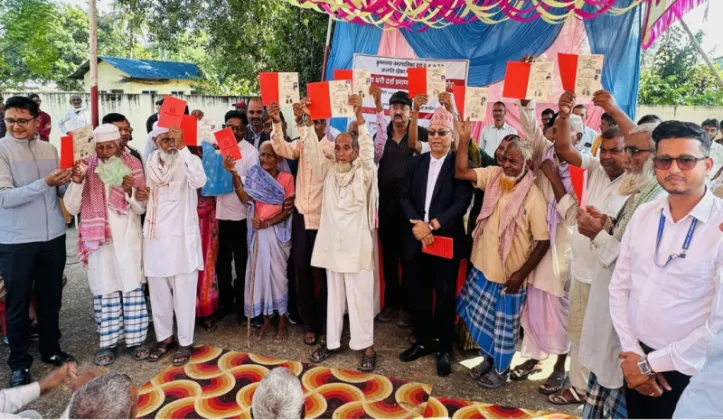
A long wait for formal land rights has ended for hundreds of families in Krishnanagar Municipality of Kapilvastu district, after 261 households received land ownership registration certificates, popularly known as lalpurja, for their village-block land. The certificates were handed over at a distribution programme held in Ward No. 9 of the municipality, in an event jointly organised by Krishnanagar Municipality and the Survey Office based in Taulihawa, Kapilvastu. News of the distribution was carried this week by national outlets including Gorkhapatra, Nepal Press and RatoPati.
For the recipient families, the red-covered certificates represent far more than paper: they are the first official, state-issued proof that the land they live on and farm is legally theirs. Village-block parcels, which are common in parts of the Terai, have long been a source of uncertainty for the households cultivating them, and the issuance of lalpurja is expected to bring that uncertainty to a close for the families concerned.
Recognition after a long wait
The distribution programme was held in Ward No. 9 of Krishnanagar Municipality, with the municipality and the Survey Office in Taulihawa jointly organising the event. According to the municipality, landowners from three wards of the municipality benefited from the latest round of certificate distribution.
Key details of the distribution include:
- A total of 261 families received land ownership registration certificates for village-block land.
- Recipient households came from Ward No. 1, Ward No. 7 and Ward No. 9 of Krishnanagar Municipality.
- Ward No. 1 alone accounted for 73 of the certificates, according to the municipality.
- The event was organised jointly by the municipality and the Taulihawa-based Survey Office of Kapilvastu.
The reference to a "long wait" in reports of the distribution underlines how long these families have lacked formal documentation for the plots they occupy. In land administration practice across Nepal, households on village-block land frequently farm and inhabit such parcels for years, sometimes generations, without individual ownership papers, which leaves them in a precarious position when disputes arise or when they seek to use their land as a financial asset. The lalpurja distribution in Krishnanagar addresses precisely that gap for the 261 households now holding certificates.
What the lalpurja changes for families
A land ownership registration certificate is the strongest documentary evidence of ownership within Nepal's land administration system. With a lalpurja in hand, a family's claim to its plot is recorded in the official register maintained through the survey and land revenue administration, replacing informal or inherited arrangements with a legally recognised title.
The practical implications for the recipient households in Krishnanagar are significant. Formal ownership allows families to buy, sell or transfer land through legal channels, to register inheritances cleanly for the next generation, and to seek clearer resolution when boundary or possession disputes emerge. A registered plot can also serve as collateral, opening the door to formal credit for households that previously had no asset the banking system would recognise. In rural and semi-urban communities of the Terai, where land remains the principal household asset, the arrival of the certificate often marks the moment a family moves from de facto possession to full, documented ownership.
The fact that recipients span three wards, 1, 7 and 9, suggests the distribution reached a broad cross-section of the municipality's village-block landholders, with Ward No. 1's 73 households forming the largest single known share of the total.
The wider picture on village-block land
Village-block land has been a persistent feature of land administration in Kapilvastu and across the Terai belt. Under this arrangement, large parcels of land were recorded as blocks in official records rather than being parcelled out and registered in the names of individual owners. Families settled on such land cultivate it, build homes on it and pass it down, yet without individual certificates their ownership exists in practice but not on paper.
The distribution of lalpurja to village-block landholders is therefore treated as a milestone in local land governance. It reflects coordination between the local government, which convenes and hosts such programmes, and the technical machinery of the Survey Office in Taulihawa, which handles the surveying, verification and registration work behind the certificates. For a municipality like Krishnanagar, sitting close to the India border in western Kapilvastu, formalising these holdings carries added weight, since undocumented land in border-area settlements has historically been vulnerable to disputes.
While the certificates distributed in Ward No. 9 mark a resolution for the 261 families involved, they also highlight the scale of the remaining task. Village-block parcels elsewhere in the municipality and the district continue to await similar processing, and the Krishnanagar programme offers a template for how the municipality and the Survey Office can convert those informal holdings into registered ownership in future rounds.
A small discrepancy in the count
Most reports of the distribution, including the municipality's own account, put the number of recipient families at 261. One report, however, placed the number of recipient households at 269, a slight difference that has not been reconciled in the available reporting. What all accounts agree on is the substance of the event: hundreds of families in Wards 1, 7 and 9 of Krishnanagar Municipality walked away from the Ward No. 9 programme holding state-issued land ownership certificates for their village-block land, closing a chapter of uncertainty that had lasted far too long.
For now, the focus in Krishnanagar is on the families themselves. A lalpurja does not change the soil beneath a household's home, but it changes the family's standing before the state, the banks and their neighbours, and for 261 households in this corner of Kapilvastu, that change finally arrived this week.