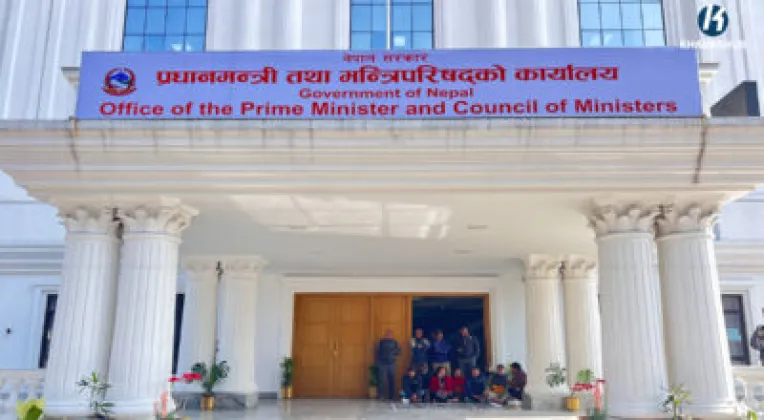
The Office of the Prime Minister and Council of Ministers (OPMCM) made public its weekly activities and progress report at a press conference in Kathmandu on Friday, laying out a consolidated account of the government's work over the past week. OPMCM Joint Secretary and Spokesperson Hemraj Aryal briefed reporters on the document, which covers government initiatives in security management, policy development, public service delivery and investment promotion. The report also addresses national policy, investment and human rights, positioning the briefing as a wide-ranging snapshot of the executive's recent activity for journalists and the wider public.
A Formal Briefing from the Heart of Government
Friday's press conference formed part of the OPMCM's established practice of making its weekly progress report public. Rather than circulating the document quietly, the Prime Minister's Office presented it through an open media briefing in Kathmandu, with its designated spokesperson delivering the account of the week's activities to assembled reporters.
That spokesperson, Joint Secretary Hemraj Aryal, serves as the official voice of the OPMCM in its dealings with the press. His briefing on Friday followed the office's routine of summarizing the report's contents for the media, ensuring that the government's weekly record reaches the public through Kathmandu-based newsrooms.
For journalists, the weekly release provides a regular and documented point of contact with the government's central administrative machinery. It gives editors and reporters a structured basis for covering what the executive says it has accomplished, and it frames the government's own priorities in its own words. Details of the briefing were carried by Khabarhub and Ratopati.
What the Weekly Report Covers
According to the briefing, the report spans several core areas of government work:
- Security management: initiatives related to managing the country's security situation.
- Policy development: work on the formulation and advancement of government policy.
- Public service delivery: measures connected to services provided to citizens.
- Investment promotion: efforts to attract and facilitate investment.
Beyond these operational headings, the report also addresses national policy, investment and human rights. The breadth of that coverage reflects the range of responsibilities that sit with the Office of the Prime Minister and Council of Ministers, which functions as the coordinating hub of the Nepal government and touches on nearly every sector of public administration.
Security and Policy Development
The report's attention to security management places on record the government's continuing engagement with one of the state's most fundamental responsibilities. Security management remains a permanent concern of any administration, and its inclusion among the week's reported activities signals that the matter featured in the executive's agenda over the period covered.
Policy development likewise occupies a central place in the report. For the office that steers the national administration, the steady work of shaping, revising and advancing policy is a defining function, and the weekly report is the vehicle through which that work is publicly logged week after week.
Services, Investment and Human Rights
Public service delivery, another headline area of the report, speaks directly to citizens' everyday interaction with the state. Governments are judged in large part on how effectively they deliver services, and the OPMCM's decision to include service delivery in its weekly account underscores the importance the office attaches to that dimension of governance.
The report's coverage of investment promotion, alongside investment as a broader theme, aligns with the economic priorities that dominate Nepal's development agenda. Its presence in the weekly report indicates continued attention to the policy environment that shapes investment in the country.
Human rights, meanwhile, appears next to national policy among the report's thematic concerns, ensuring that the week's summary is not confined to administrative and economic matters alone but extends to questions of rights and broader national direction.
Transparency and the Weekly Reporting Cycle
The public release of a weekly progress report is, at its core, a mechanism of transparency. By regularly publishing what it has been doing, the government invites scrutiny of its record and gives citizens a running account of executive activity. The press conference format adds a further layer to that openness, allowing reporters to hear the report summarized directly by the OPMCM's spokesperson and to treat the office's own account as the baseline for their coverage.
For the OPMCM itself, the cycle also serves as a form of internal discipline. Compiling a weekly account of activities across security management, policy development, public service delivery, investment promotion, national policy and human rights requires the office to track its work continuously and to present it in a form that can withstand public attention.
Friday's release in Kathmandu thus marks both an ending and a beginning: the close of one reporting week, with the government's record once again placed on the public record, and the start of another cycle in which the Prime Minister's Office will be expected to account for its activities when the next report comes due.