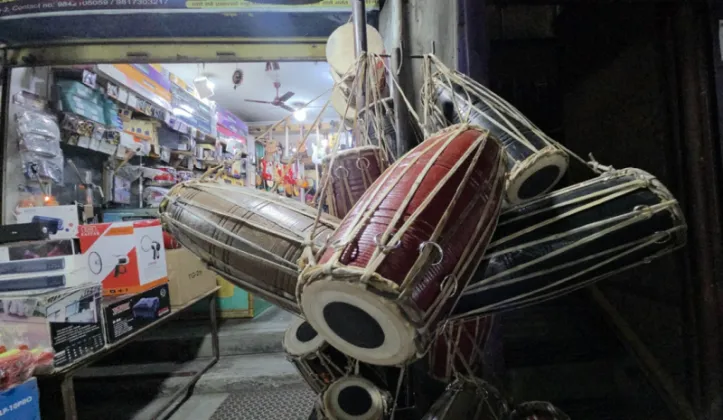
Sales of the madal, Nepal's traditional hand drum, have risen in Sunsari district as the Tihar festival approaches, with music traders in Dharan reporting a surge in demand driven by groups preparing for the festival's Deusi-Bhailo performances. Shopkeepers said buyers have been arriving at instrument stores in recent days to pick up drums ahead of the five-day festival of lights, when revellers move door to door singing traditional songs, making the instrument that sets their rhythm one of the season's most sought-after purchases. According to a report by Gorkhapatra Online, the growing use of digital sound systems has done little to loosen the drum's hold on the festival tradition.
Deusi-Bhailo groups lift festival-season sales
Suman Chaudhary, operator of Salsa Music Store at Chhatachowk in Dharan-2, said madal sales rise during Tihar, a pattern his shop has come to associate with the festival season. Located in one of Dharan's busiest commercial areas, the store has been receiving a steady flow of buyers as neighbourhood groups make their preparations for the festive nights. Pradeskhabar also carried a report on the rising sales, reflecting the seasonal demand seen across the district.
The reason for the demand is built into the festival itself. Deusi-Bhailo groups, usually formed of neighbours and friends, spend the Tihar nights moving from house to house, singing festive verses at each doorstep. The madal is the instrument that keeps such singers together, providing the beat that carries them along the lanes from one home to the next. For groups determined to perform the tradition properly, the drum is close to indispensable, and that requirement translates directly into sales for instrument shops in the weeks before the festival begins.
Hand-played beat outlasts digital sound
Traders say the attraction of the madal in Deusi-Bhailo has not declined despite the growing use of digital sound systems. Portable speakers and recorded music have become a familiar feature of celebrations across Nepal, accompanying everything from weddings to cultural programmes. Yet when it comes to Tihar's door-to-door carolling, sellers in Sunsari report that buyers continue to reach for the traditional drum rather than depending on amplification alone.
The traders' observation points to a practical distinction between the two. Deusi-Bhailo is built on live singing, with verses offered at each household and responses exchanged between the singers and their hosts. A hand-played drum follows the group wherever it goes, matching its pace and its voice, while a sound system can only project a fixed recording. In that setting, the madal's portability and its responsiveness to the player's hands have kept it at the centre of the ritual, and the rising sales in Sunsari suggest that festival-goers continue to see it that way.
A festival of songs, lights and offerings
Tihar, also known as Deepawali, is among Nepal's most widely celebrated festivals, observed over five days with distinct traditions marking each day:
- Kag Tihar, the day of the crow, opens the festival
- Kukur Tihar honours the dog
- Laxmi Puja, dedicated to the goddess of wealth, lights up homes with oil lamps, candles and decorative lights
- Goru Tihar and Govardhan Puja honour the ox
- Bhai Tika closes the festival, when sisters place tika on their brothers' foreheads
Running through these days is the tradition of Deusi and Bhailo, the festive carols sung by groups of revellers as they visit households in their neighbourhoods. Hosts traditionally welcome the singers with offerings of money, sel roti, fruit and sweets, along with good wishes for the year ahead. The songs are passed down through generations, and the madal has long provided their accompaniment, making the drum an enduring symbol of the season.
The madal itself is a two-headed drum held horizontally and played with both hands, and it is regarded as a backbone of Nepali folk music. Its steady, resonant beat accompanies folk songs across the hills and the plains alike, and its place in Deusi-Bhailo has made it a fixture of the Tihar soundscape in towns and villages across the country.
Steady demand ahead of the festival days
With Tihar drawing near, instrument sellers at Chhatachowk expect continued interest from groups making their final preparations for the Deusi-Bhailo rounds. For traders such as Chaudhary, the season confirms a pattern they have long observed: year after year, as the festival approaches, the madal becomes the item buyers ask for first, a sign that the hand-played beat of the traditional drum still defines how Tihar is celebrated in Sunsari.