The famous Pathibhara temple in Taplejung district has collected Rs 3,326,000 in cash offerings from devotees over a three-month period, according to reports in Nepali media. The amount, which crosses Rs 3.3 million, came entirely from voluntary offerings made by worshippers who travelled to the high-altitude shrine in eastern Nepal to offer prayers. The figure provides a rare numerical glimpse of the steady stream of pilgrims who continue to make their way up to one of the country's most revered religious sites, perched on a ridge of the Kanchenjunga range.
Voluntary Offerings Total Rs 3,326,000
According to reports published by Nagarik News and Pradesh Khabar, the temple's collection for the three-month period stood at Rs 3,326,000. The reports describe the money as offerings presented by devotees of their own free will as part of their worship at the shrine. There was no compulsion of any kind attached to the contributions; the total is simply the sum of the cash that individual worshippers chose to place before the goddess during their visits.
Key facts from the reports:
- Total collected: Rs 3,326,000
- Period covered: Three months
- Nature of the funds: Voluntary cash offerings from devotees
- Location: Pathibhara temple, Taplejung district, Koshi Province, eastern Nepal
- Reported by: Nagarik News and Pradesh Khabar
At major shrines across Nepal, collections of this kind are counted and recorded by the temple's management, and such funds generally go toward the day-to-day operation of the temple, the upkeep of the premises and the services provided to pilgrims. Whatever the specific arrangements at Pathibhara, the reported total confirms that voluntary giving remains an important source of the shrine's income. Collections at prominent temples are closely watched in Nepal, where religious tourism forms a significant part of the wider economy of the hills.
A Shrine on the Shoulder of Kanchenjunga
Pathibhara Devi temple stands at an altitude of roughly 3,794 metres on a ridge that falls on the shoulder of the Kanchenjunga massif, and it lies about 20 kilometres from Phungling, the headquarters of Taplejung district. The temple is regarded as one of the prominent Shakti Peethas of Nepal, a place where the goddess Pathibhara is worshipped as a deity whose blessings are sought for prosperity, family wellbeing and the fulfilment of wishes. Devotees travel to the site from across Nepal as well as from India, and the temple is among the best-known religious destinations of the eastern hills.
The hilltop is also sacred to the indigenous Limbu community, who know the site as Mukkumlung. In recent years, the identity of the sacred site has figured in national conversations, with the Limbu community seeking recognition of Mukkumlung as a place of its own cultural and religious significance. The name Pathibhara, meanwhile, remains the one most widely used by the pilgrims who fill the temple on festival days and auspicious dates.
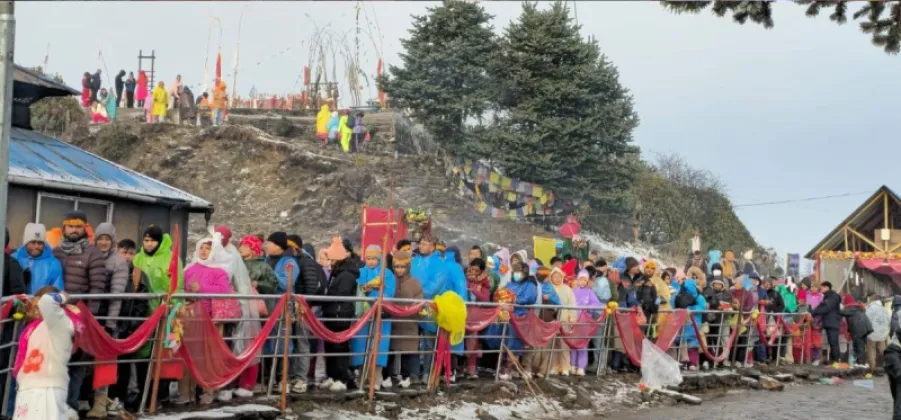
The approach to the temple is an act of devotion in itself. Pilgrims must leave the road behind and walk for several hours up a mountain trail that climbs through forest before opening out at the shrine. Because of the effort involved, reaching Pathibhara is often described as a pilgrimage that combines faith with physical endurance. The temple's location beneath the world's third-highest peak, Mount Kanchenjunga at 8,586 metres, adds to its draw, and many visitors combine the journey with the wider attractions of the Kanchenjunga region, which is also popular with trekkers.
What the Collections Say About Devotion
Three months of steady contributions point to the scale of footfall the temple continues to command. Offerings of cash are typically made one by one, as each devotee completes worship at the shrine, so a total of Rs 3,326,000 represents a large number of individual acts of giving rather than a few large donations. Crowds at Nepali hill shrines usually swell during major festivals and on auspicious dates in the Nepali calendar, and Pathibhara is no exception, with devotees often timing their visits to coincide with special worship.
As with most pilgrimage trails in Nepal, the steady flow of worshippers also sustains the small tea shops and lodges along the route that depend on pilgrims for their livelihood. The climb, the offerings and the services that have grown around the trail together form an economy of faith centred on the hilltop shrine.
The reports did not disclose a month-by-month breakdown of the collections or a comparison with previous periods. Even so, the published total stands as the latest measure of the devotion the shrine commands. For a temple reached largely on foot at an altitude of nearly 3,800 metres, the Rs 3,326,000 gathered from voluntary offerings in just three months is a quiet but telling indication of how deeply Pathibhara remains woven into the religious life of eastern Nepal, and of the pilgrims who continue to climb the mountain trail to stand before the goddess.