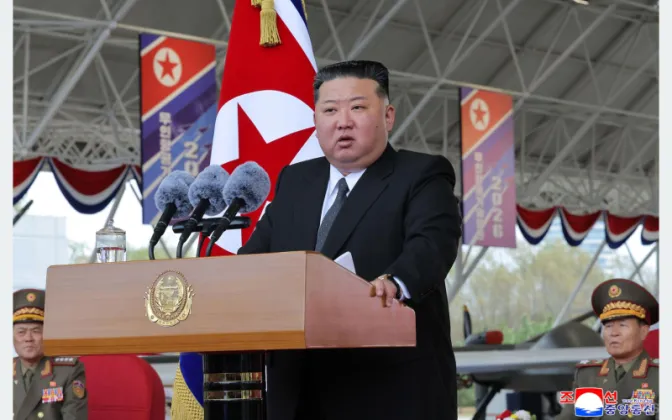
North Korea launched an unknown type of missile from its eastern coast on Wednesday, firing the projectile toward the sea in the country's latest weapons test, according to the South Korean military. The launch comes at a delicate moment: Pyongyang faces allegations of hacking even as the prospect of renewed diplomacy with Washington has re-emerged, with US President Donald Trump expressing willingness to resume dialogue with North Korean leader Kim Jong Un. South Korean authorities did not immediately provide details about the missile's type, but the launch confirms that North Korea's weapons-testing activity continues even as the possibility of talks between Washington and Pyongyang comes back into view.
What is known about the launch
South Korea's military, which keeps close watch on test activity across the border, detected the launch from North Korea's eastern coastline on Wednesday. According to reports on the launch, the missile was fired toward the sea and has so far been described only as an unknown projectile.
The confirmed details at this stage are limited:
- What happened: North Korea fired a missile toward the sea
- When: Wednesday
- Where from: The country's eastern coast
- Missile type: Unknown, pending further analysis
- Who reported it: The South Korean military
The lack of immediate specifics is common in the hours after such a launch. Militaries in the region typically collect and cross-check radar, satellite and other surveillance data before releasing assessments of a projectile's type, range and altitude, and until that work is complete, launches are frequently labeled unknown. Nepali-language reporting on the test likewise noted that the missile's identity had not been made public.
What the initial reporting does establish is continuity. North Korea's testing rhythm has not paused, and Wednesday's launch adds to a pattern in which Pyongyang periodically fires projectiles from its coasts into the sea. Such tests serve a dual purpose: they allow engineers to gather flight data on its systems, and they keep international attention fixed on the North's arsenal.
A diplomatic opening, and hacking allegations, frame the timing
The most notable aspect of the launch is when it occurred. It comes amid allegations of hacking, an accusation that has added another layer of friction around Pyongyang at precisely the moment diplomacy is being floated. At the same time, Trump has expressed willingness to resume dialogue with Kim Jong Un, a signal that Washington may be prepared to revive leader-level engagement with North Korea.
That combination of an outstanding accusation and an offered dialogue is a familiar setting for North Korean missile launches. Tests conducted during windows of potential diplomacy are rarely neutral events for Pyongyang. They demonstrate that its weapons programs continue regardless of the diplomatic calendar, and they underline that any future negotiations would have to take account of the capabilities the North has built in the meantime.
For the United States, Trump's stated openness to dialogue suggests an interest in exploring whether talks can steady the relationship. For North Korea, continued testing signals that it intends to negotiate, if negotiations happen, from a position of strength rather than concession. The two tracks, pressure through weapons development and the possibility of dialogue, are thus running in parallel, and Wednesday's launch sits squarely at their intersection.
Weapons tests as negotiating leverage
According to the reporting, Pyongyang has continued its weapons tests as it seeks to strengthen its position in potential negotiations with Washington. In other words, the missile fired on Wednesday should be read not only as a military event but as a bargaining one: every test adds hardware and data to the North's arsenal and, by extension, adds weight to its side of any future negotiating table.
This logic shapes how launches like Wednesday's are typically interpreted. A country that tests while offering to talk is signaling confidence, insisting that counterparties engage with it as it is now, not as it was when dialogue last paused. Trump's willingness to resume dialogue with Kim Jong Un suggests that channel remains alive in principle; North Korea's decision to keep launching suggests it sees no reason to slow its weapons work while that channel is considered.
Whether the latest launch prompts a response in Washington, or is folded into the run-up to any renewed talks, will become clearer in the days ahead. For now, the picture is of a North Korea that is simultaneously testing weapons, contesting accusations of hacking and holding open the prospect of dialogue, all at once.