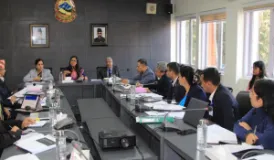
Nepali Congress General Secretary Pradeep Poudel has launched a sharp attack on the government, accusing it of failing on two of the country's most pressing challenges - the management of squatters and the spiraling cost of living. Poudel made these remarks while speaking at a program in Dhading, where he said the ruling authorities had not only neglected the squatter issue but had actually contributed to its creation in the first place.
Government Blamed for Creating and Abandoning the Squatter Problem
In his address in Dhading, Poudel alleged that the government itself is responsible for creating the squatter problem in the country. According to him, those in power allowed the issue to take root and then simply walked away from it, leaving thousands of affected families in a state of prolonged uncertainty.
"The government created the squatter problem itself and then left it unattended," Poudel said, adding that the authorities have failed to come forward with any concrete plan that could permanently resolve the issue. He stressed that what the country needs is not ad hoc arrangements or temporary relief measures, but a lasting, well-thought-out solution that addresses the root causes of landlessness and informal settlements.
His comments come at a time when the squatter issue continues to generate debate in the country, with successive governments struggling to identify genuine beneficiaries, rehabilitate those in need, and clear public land that has been occupied over the years. Poudel's charge that no serious policy work has been done underlines the opposition's view that the current administration has treated the matter as a low priority.
Rising Prices and the Failure to Control Inflation
Alongside his criticism of the government's handling of the squatter issue, Poudel also took aim at its economic performance. He said the government has completely failed to control inflation, a burden that, according to him, is being borne hardest by ordinary Nepalis who struggle daily with the rising cost of essential goods and services.
The Nepali Congress leader's remarks reflect a broader concern about price escalation that has persisted in the country, with consumers facing increased costs on daily necessities. By linking the two issues, Poudel sought to portray a government that is failing both in its social responsibilities, such as providing land and shelter security to the landless, and in its basic economic duty of keeping prices stable.
He argued that these twin failures demonstrate a lack of seriousness on the part of those running the government, saying that neither the plight of squatters nor the squeeze of inflation on household budgets has been met with the urgency they deserve.
Opposition Congress Steps Up Its Criticism
Poudel's statements in Dhading add to the Nepali Congress's ongoing role as the main opposition force holding the government accountable on governance and livelihood issues. As General Secretary of the party, his public criticism carries weight within the party's campaign to highlight what it sees as the government's shortcomings.
By raising the squatter and inflation issues in a public forum in Dhading, Poudel signaled that the Congress intends to keep these topics at the center of its political discourse. His accusation that the government has no concrete plan for a permanent solution to the squatter problem, coupled with its failure on rising prices, sets the tone for the party's expected pressure on the administration in the days ahead.
For now, Poudel's message from Dhading is clear: the government must stop sidestepping its responsibilities and come forward with real, lasting answers on both the squatter crisis and inflation, rather than leaving ordinary citizens to bear the consequences of its inaction.