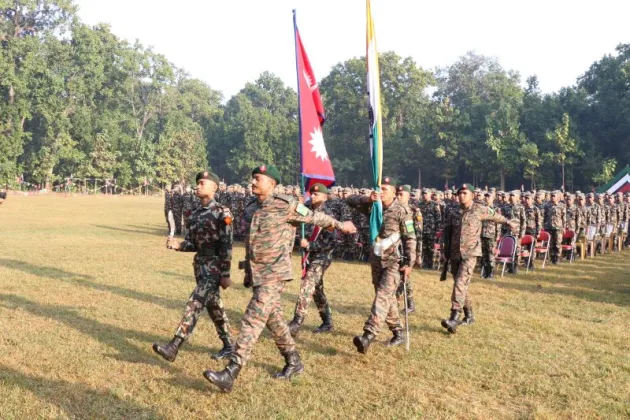
The Nepal-India joint military exercise 'Suryakiran' has formally begun at Saljhandi, marking the latest instalment of a long-running training programme conducted between the armies of the two neighbouring countries. The drill is being held under the defence and security cooperation framework shared by Nepal and India, and it brings together soldiers from both national armies for combined training designed to build interoperability and mutual understanding.
A Joint Training Programme Between Two Armies
The exercise, known as 'Suryakiran', is a joint training programme between the Nepali Army and the Indian Army. Such exercises are a regular feature of the military-to-military relationship between the two countries, and they are organised with the objective of sharing skills, procedures and professional expertise between the two forces.
By conducting the drill at Saljhandi, the two armies are once again training together on Nepali soil, in line with the established practice of alternating and sharing venues for bilateral exercises. The training brings personnel from both sides into a common environment where they can practise coordinated operations, exchange tactical knowledge and strengthen the working relationships that underpin cooperation between the two militaries.
Conducted Under Defence and Security Cooperation
The exercise is being held under the defence and security cooperation that exists between Nepal and India. Defence ties between the two neighbours have historically been among the closest pillars of their broader bilateral relationship, with the armies of both countries sharing long-standing traditions, similar organisational structures and a history of joint engagement.
Joint military exercises such as 'Suryakiran' form a visible component of this cooperation. Alongside high-level visits, training exchanges and institutional links between the two army headquarters, combined drills provide a practical platform for soldiers to work side by side. According to reports, the current exercise at Saljhandi has been organised within this established framework of bilateral defence engagement.
The Purpose of Combined Military Drills
Joint exercises between friendly armies typically serve multiple purposes. They allow participating units to rehearse coordinated procedures, familiarise themselves with each other's equipment and methods, and develop the personal and professional contacts that make future cooperation smoother. For the Nepali and Indian armies, whose personnel often serve together in United Nations peacekeeping operations as well, such familiarity carries practical value beyond the exercise itself.
The 'Suryakiran' series has been one of the recognised bilateral exercises between the two countries, and each iteration provides an opportunity for both sides to refine shared doctrines and strengthen trust at the working level. The commencement of the drill at Saljhandi continues this pattern, keeping the regular rhythm of military engagement between Kathmandu and New Delhi intact.
Significance for Nepal-India Relations
The launch of the exercise comes at a time when defence and security cooperation remains a key element of Nepal-India relations. The two countries share an open border and deep people-to-people ties, and their security establishments cooperate on a range of issues of mutual concern. Military exercises like 'Suryakiran' are a tangible expression of that partnership.
For the Nepali Army, participation in such drills offers exposure to the training standards and operational practices of one of the world's largest armies, while for the Indian Army, the exercise reinforces engagement with the military of a close and historically linked neighbour. The conduct of the exercise at Saljhandi also highlights Nepal's role as an active host for bilateral military training on its own territory.
Looking Ahead
As the exercise gets underway at Saljhandi, both armies are expected to carry out the planned training activities under the agreed programme. The drill's commencement has been reported by Nepali news outlets, including Thaha Khabar and Nepal Lead, which noted that the exercise is part of the ongoing defence and security cooperation between the two countries.
The 'Suryakiran' exercise adds to the series of joint engagements that the Nepali and Indian armies have conducted over the years, and its latest edition at Saljhandi underscores the continuity of military-to-military ties between the two neighbours. Further details about the training activities, participating contingents and the duration of the exercise are expected to be shared as the drill progresses.