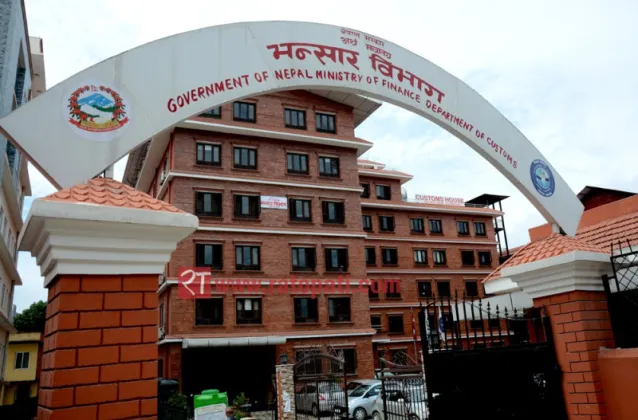
Soybean oil has emerged as the single largest commodity in both Nepal's imports and exports during the first four months of the current fiscal year, underlining the country's unusual pattern of trading heavily in processed goods re-exported to third markets. Data released by the Department of Customs on Wednesday showed that Nepal imported goods worth Rs 803.10 billion in the period from Shrawan to Kartik of fiscal year 2083/84, while exports stood at Rs 134.15 billion over the same four months.
The figures highlight the wide gap between what the country buys from abroad and what it sells. Against total imports of Rs 803.10 billion, exports of Rs 134.15 billion amount to less than a fifth of the import bill, leaving a trade imbalance of roughly Rs 668.95 billion in just four months.
Soybean oil dominates the import list
Crude soybean oil was the top import item in the review period, with imports valued at Rs 62.81 billion. In terms of volume, Nepal brought in 354.5 million litres of crude soybean oil during the four months. The shipments came mainly from Argentina and China, along with other countries, reflecting Nepal's reliance on a small group of supplier nations for the commodity that now tops its import basket.
That a single edible oil product leads the country's entire import bill illustrates how concentrated Nepal's external trade has become. No other product group mentioned in the customs data comes close to the Rs 62.81 billion worth of crude soybean oil brought in during the period.
Exports up sharply, driven by the same commodity
Interestingly, the same commodity also heads the export list. Soybean oil accounted for 46 percent of Nepal's total exports in the first four months of the fiscal year, valued at Rs 61.34 billion. In volume terms, the country exported 254.1 million kg of soybean oil during the period.
The export figure is notable not just for its size but for its growth. Overall exports rose 43.48 percent in the review period, and the surge in soybean oil shipments was the driving force behind that increase. The pattern, in which Nepal imports crude soybean oil, refines it domestically and ships much of it back out, has become a defining feature of the country's trade statistics.
Other export earners trail far behind
Beyond soybean oil, Nepal's export basket remains narrow. Carpets, one of the country's traditional export products, fetched Rs 3.89 billion in the four-month period, ranking among the top export items. Cardamom, another long-standing export commodity, also featured prominently in the list of leading exports.
The contrast between the leading export and the rest of the basket is stark. While soybean oil alone earned Rs 61.34 billion, carpets, the next major item cited in the data, brought in Rs 3.89 billion, a fraction of the top earner's value. This concentration means the country's overall export performance depends heavily on the fortunes of a single commodity chain.
What the four-month figures show
Taken together, the customs data for Shrawan to Kartik present a mixed picture of Nepal's external trade. On one hand, the 43.48 percent growth in exports points to improved momentum in the country's overseas sales. On the other, imports of Rs 803.10 billion remain several times larger than export earnings, keeping the trade gap wide.
The dual dominance of soybean oil at the top of both lists is the most striking feature of the data. The country imported 354.5 million litres of the crude product and exported 254.1 million kg of the refined oil in the same four months, showing the scale at which the commodity now moves through Nepal's trade economy.
The Department of Customs releases these periodic trade figures to track the flow of goods across the country's borders, and the Shrawan-Kartik data for fiscal year 2083/84 provides the first substantial read on how the current fiscal year's trade is shaping up. With Rs 803.10 billion in imports and Rs 134.15 billion in exports in just four months, the pace of trade activity is running high, and the coming months will show whether the export growth of the review period can be sustained while the import bill is kept in check.