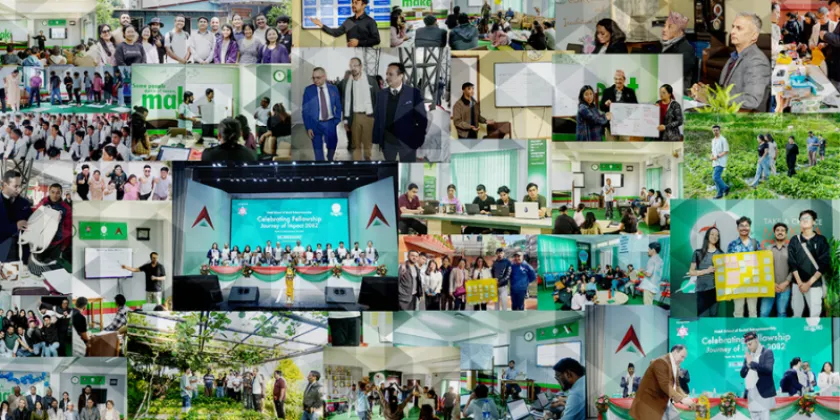
The Nabil School of Social Entrepreneurship (Nabil SSE), the flagship social entrepreneurship programme of Nabil Bank Limited, has completed five years since its launch on 26 November 2021. Over the past five years, the programme has supported the establishment of 318 enterprises across Nepal while equipping 1,580 people with entrepreneurial knowledge and skills.
According to figures released on the occasion of the fifth anniversary, the initiative has generated more than 19,303 direct and indirect employment and livelihood opportunities. Trained entrepreneurs under the programme have developed solutions in diverse sectors including experiential tourism, local agriculture, drone technology and information technology.
Five years of building social entrepreneurs
Since its establishment in 2021, Nabil SSE has positioned itself as a dedicated platform for nurturing social entrepreneurs in Nepal. The programme's core focus has been on training individuals in entrepreneurial knowledge and skills, enabling them to translate ideas into functioning businesses that address local needs.
The milestone of 1,580 trained participants over five years reflects the scale of the school's outreach. From this pool of trainees, 318 enterprises have been formally established, demonstrating the programme's role in converting training into tangible business activity. The enterprises span a range of sectors, from experiential tourism and local agriculture to drone technology and information technology, indicating the breadth of entrepreneurial interest among its graduates.
Employment and livelihood impact
The most significant outcome highlighted at the five-year mark is the creation of over 19,303 direct and indirect employment and livelihood opportunities. These jobs stem from the enterprises founded by the programme's trained entrepreneurs, whose ventures have had ripple effects on employment in their respective communities.
The emphasis on social entrepreneurship distinguishes the initiative from conventional business incubation. By directing support toward enterprises that combine commercial viability with social value, the programme has sought to address local challenges through market-based solutions. The sectors where its entrepreneurs operate, such as local agriculture and experiential tourism, are closely tied to Nepal's rural economy and tourism potential, while newer areas like drone technology and information technology point to the emerging technology orientation among Nepali entrepreneurs.
Banking and social enterprise in Nepal
Nabil Bank Limited, one of Nepal's prominent commercial banks, launched the school as its flagship social entrepreneurship programme, marking a notable example of a financial institution investing in enterprise development beyond traditional banking services. The initiative reflects a growing interest among Nepali banks in supporting entrepreneurship and livelihood generation as part of their broader social engagement.
The fifth anniversary, observed on 26 November, served as an occasion to take stock of the programme's cumulative achievements. With 318 enterprises established, 1,580 people trained and over 19,303 employment and livelihood opportunities created, the institution says the programme has demonstrated measurable results over its first five years of operation.
The programme's progress will likely be watched as an indicator of how structured training and enterprise support can contribute to job creation in Nepal, where employment opportunities remain a key development priority. As Nabil SSE enters its next phase, the accumulated experience of its first five years, from training methodologies to the sectors its graduates have entered, forms the foundation on which future cohorts of social entrepreneurs are expected to build.
For more details, the five-year milestone was reported by Nepal Press, Rato Pati and News of Nepal.