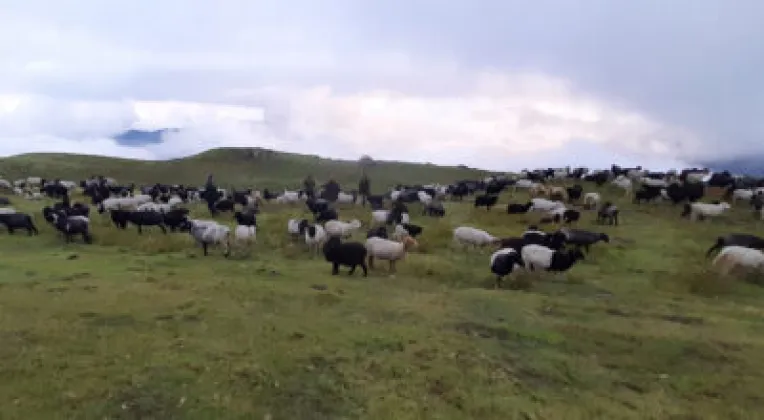
Livestock sheds across Myagdi district have begun the slow move down from the highland pastures to the grazing lands near the villages, as autumn sets in and the cold begins to tighten its grip. The sheds, which had stood through the monsoon on the high pastures known locally as buki, are now being shifted to the lower khark, the grazing areas that lie closer to settlements. Cattle, buffalo, sheep and goats that had climbed to the foothills of the Himalayas during the rainy season are being brought down to graze within easier reach of the villages, continuing a seasonal migration that remains at the heart of animal husbandry in the district.
Autumn sets the herds in motion
With the onset of autumn and the steadily rising cold, herding households across the district have started bringing their animals down from the buki. The high pastures, which offer open grazing during the monsoon months, turn harsh once temperatures begin to fall, and herders respond by moving their livestock to the khark that lie lower down the hillsides, nearer to the villages where the animals can be tended through the cold season.
The animals on the move include cattle, buffalo, sheep and goats, the livestock that many families in the district have traditionally reared. Local outlets, among them Rato Pati and Nagarik News, reported that the mobile cattle sheds have started to come down toward the valley, a movement that takes place each year as the season turns.
Harkabir Bika of Dhawalagiri Rural Municipality-1, Gurja, is among the herders whose animals spent the monsoon in the highlands. According to a report by Khabarhub, Bika said three of his animals were kept at Phagune's buki. His herd, like others scattered across the district's high pastures, has now begun the descent toward lower ground.
The seasonal rhythm of transhumance
The movement is part of a practice known as transhumance, in which herders shift their livestock between pastures according to the season rather than keeping them in one place year round. In Myagdi, the cycle follows a broadly settled pattern:
- Monsoon ascent. When the rains arrive, herds travel up to the buki, the highland pastures near the foothills of the Himalayas, where the animals graze through the wet months.
- Autumn descent. With the onset of autumn and rising cold, the sheds begin to come down and are moved to the khark, the grazing areas closer to villages and settlements.
- Cold-season grazing. The shift places the animals within easier reach of the households that tend them during the colder months of the year.
This year's descent
This year, too, the movement has begun as the season has turned, with sheds descending from the high pastures to the lower khark. The rhythm is dictated by the weather rather than by fixed dates on the calendar: herders head uphill when the monsoon opens up the high grazing grounds and come back down as the cold sets in at altitude.
For the villages that take part, the cycle is an annual landmark. The sight of sheds and herds on the trails between the buki and the khark signals the change of season just as clearly as the falling temperatures that drive it.
Keeping ancestral animal husbandry alive
For the farming households of Myagdi, the seasonal migration is more than a matter of grazing management. It is the practice that sustains ancestral animal husbandry in the district, a system of livestock rearing handed down within families and organised around the natural movement between high and low pastures. Rearing cattle, buffalo, sheep and goats in this way remains an inherited occupation, carried on season after season in the same pattern as before.
Local reporting has framed this year's descent in exactly those terms. Rato Pati described the mobile herds coming down from the highlands as a sign that the ancestral system of animal husbandry is being preserved, while Nagarik News noted that the district's cattle sheds have begun to fall into the valley as the cold season approaches.
The continuation of the practice highlights the distinctive character of livestock farming in Myagdi. Instead of remaining in fixed shelters near the homestead throughout the year, the animals move with their keepers between the buki and the khark, following the grazing and the climate of each season.
The descent now under way marks the turn from monsoon to autumn in the district's high pastures. As the cold deepens in the weeks ahead, the livestock of Myagdi will complete their move to the lower khark, and the traditional cycle that sustains the district's ancestral animal husbandry will have come full circle for another year.