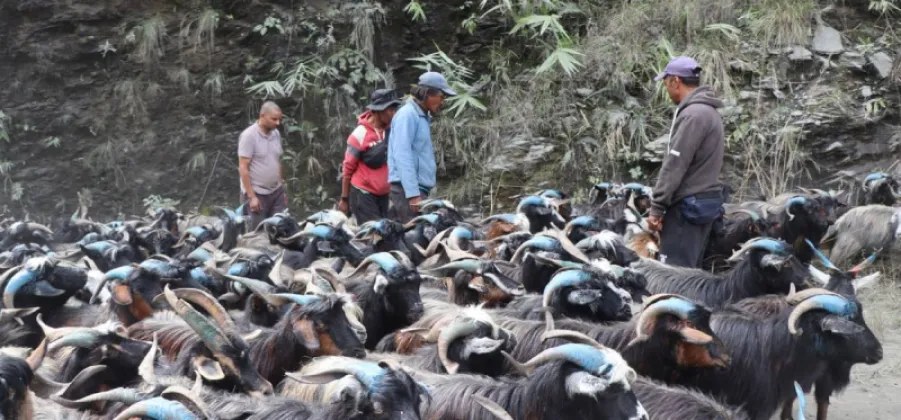
Mustang’s chyangra trade, a generations-old tradition linked to the ancient Silk Road, continues to sustain the district’s economy and culture, according to reports published by Gorkhapatra Online and Nagarik News. The trade is part of a history of trans-Himalayan commerce in which wool and salt were bartered across the region. Though its roots reach back to an earlier era of exchange, the chyangra trade remains a living heritage in Mustang today.
A trade shaped by trans-Himalayan exchange
The Silk Road connection places Mustang’s chyangra trade within a much wider history of movement and exchange across the Himalayas. The reports describe earlier commerce in which wool and salt were exchanged through barter, linking the trade to the practical relationships that sustained trans-Himalayan trade. Rather than being only a story about goods, that history reflects a way of conducting commerce built around exchange between communities.
Barter is a defining part of the trade’s historical account. Wool and salt were not simply items in a transaction; their exchange connects the chyangra trade to the wider commercial life of the region. The available reports do not present the tradition as a relic confined to the past. Instead, they frame its history as a legacy that has continued through generations and remains relevant to Mustang.
That continuity is central to the trade’s significance. The Silk Road association offers historical context, while the continued practice gives the tradition a present-day place in the district. The reports portray the old and current dimensions together: a trade with roots in trans-Himalayan exchange that still contributes to local life.
More than a historical legacy
The chyangra trade is described as a living heritage, a term that captures both its endurance and its continuing role in Mustang. Its importance is not limited to recalling earlier commerce. The reports say it still sustains the district’s economy and culture, connecting an inherited practice with the present-day identity and livelihood of the region.
That economic and cultural role helps explain why the trade remains notable. Its contribution to the local economy gives it a practical importance, while its connection to generations of tradition gives it cultural meaning. The reports do not reduce the trade to either one of these roles: it is presented as both an economic activity and part of Mustang’s heritage.
The tradition also keeps the historical story of trans-Himalayan barter visible. Wool and salt exchange is a reminder of the commercial relationships associated with the region, while the continued chyangra trade shows that Mustang’s trade heritage has not disappeared. Its past and present are therefore closely linked in the accounts: the historical connection gives context, and the ongoing practice keeps that connection alive.
Continuity across generations
The reports emphasize that the trade has continued for generations. That longevity makes it a marker of continuity in a district whose identity is connected to the history of Himalayan exchange. The available accounts do not set out a detailed chronology or describe specific changes in the trade, but they present its survival as evidence of an enduring local tradition.
For Mustang, the chyangra trade consequently represents more than a reference to the Silk Road. It is a continuing part of the district’s economic and cultural life, rooted in a history of barter and carried forward over generations. As described by Gorkhapatra Online and Nagarik News, the trade keeps that heritage present rather than leaving it solely in historical memory.