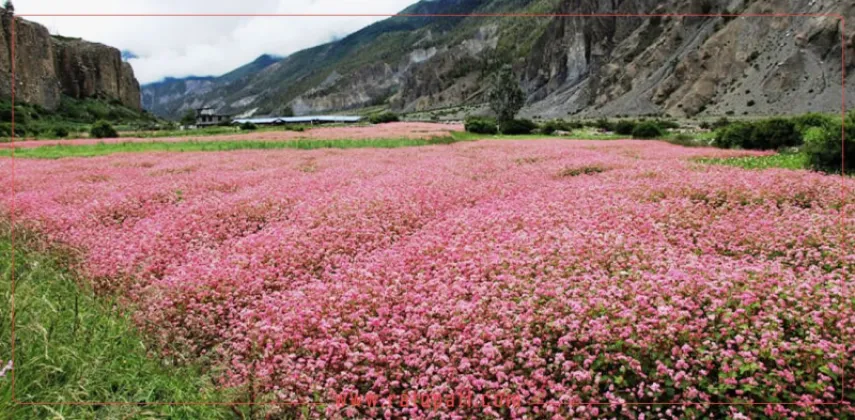
Farmers in the Himalayan district of Mustang are busy harvesting buckwheat, one of Nepal's best-known native food crops, as the autumn farm season peaks in the country's high hills. Fields sown with the crop in Asar (mid-June to mid-July) are being cleared and the grain carried home, with the harvest running through Asoj and Kartik (mid-September to mid-November), according to reports published by RatoPati, NepalPress and Khabarhub.
Harvest season reaches the high valleys
For Mustangi farmers, these weeks mark one of the busiest stretches of the agricultural year. The buckwheat sown in the fields in Asar has matured over the summer months and is now being cut, collected and brought home, with the harvest concentrated in the Asoj-Kartik period. The sequence, repeated year after year, gives buckwheat one of the clearest seasonal rhythms of any food crop grown in the district.
The harvest described in the reports is not a single-day affair. Farmers move between their plots as the crop ripens, gather the grain and carry it back to their homes, where it is stored after the fields are cleared. By the time the Asoj-Kartik window closes, the season's buckwheat has been moved from the open fields to household stores, completing a cycle that began roughly four months earlier with the Asar sowing.
A farming calendar shaped by the seasons
The timing of the crop's journey from field to home is tightly fixed. Sowing takes place in Asar, at the onset of the monsoon season, and the crop is left to develop through the summer. The harvest then falls in Asoj and Kartik, the autumn months when weather conditions favour field work across the hills. This sowing-to-harvest span defines how buckwheat fits into the annual routine of farming households in Mustang, and it explains why the district's fields are at their liveliest at this time of year.
A crop made for the high Himalaya
Buckwheat occupies a distinctive place in Nepal's farming landscape. It is grown at altitudes between 2,000 and 5,000 metres above sea level, a range in which comparatively few food crops are cultivated, and it is grown across the Himalayan and high hill districts. Mustang, with its fields spread across high-altitude terrain, sits squarely within that belt, which is why the crop has remained part of local agriculture for years.
Quick facts: buckwheat in Nepal
- Crop: Buckwheat, known locally as phapar, a native food crop
- Growing regions: Himalayan and high hill districts, including Mustang
- Altitude range: Between 2,000 and 5,000 metres above sea level
- Sowing season: Asar (mid-June to mid-July)
- Harvest season: Asoj-Kartik (mid-September to mid-November)
The altitude figures underline why the crop is so closely associated with districts like Mustang. At elevations where the growing environment is demanding, buckwheat has established itself as a dependable native food crop, cultivated in the same high-lying fields season after season. Its presence across the Himalayan and high hill districts makes it one of the most recognisable staples of Nepal's mountain agriculture.
Why the native crop matters
Buckwheat is described in the reports as one of the well-known native food crops cultivated in Nepal for years. Unlike crops introduced from outside, it has been grown in the country's high-altitude fields across generations and is adapted to the conditions that prevail in the Himalayan and high hill districts. That long history gives the annual harvest in Mustang a significance beyond routine farm work: it is the continuation of an indigenous food tradition that remains rooted in the district's fields.
The reports were published under the headline "Indigenous crops are being imported", reflecting a wider conversation about the standing of crops such as buckwheat in Nepal today. At a time when questions are being asked about the fate of native foods, the sight of Mustangi farmers busy in their buckwheat fields serves as a reminder that the crop is still actively grown in the landscapes where it has traditionally been cultivated. The harvest now underway brings that cultivation full circle, moving the season's grain from the high fields to the homes of the farmers who raised it.
With the harvest in full swing across the district, work in Mustang's buckwheat fields will continue through the Asoj-Kartik period before winding down as Kartik draws to a close, closing another cycle in one of the country's most enduring high-hill farming traditions.