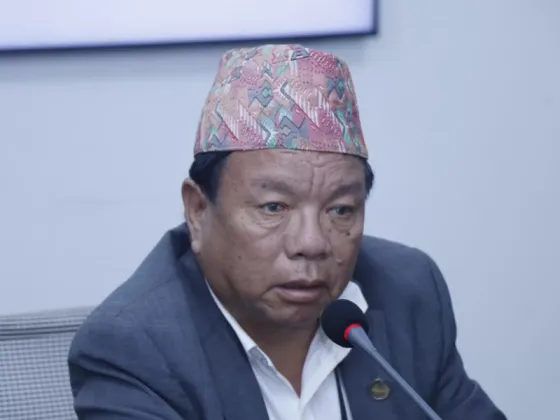
Minister for Science, Technology and Innovation Mahabir Pun has said that a study will be carried out on the possibility of reopening the long-closed Hetauda Textile Industry by upgrading its old machines with modern technology. He made the remarks during a field visit to the industrial area located in Hetauda Sub-Metropolitan City-8 on Friday.
The minister said the study will focus on whether the ageing equipment at the factory can be modified for renewed production, rather than discarding the existing infrastructure altogether. According to Pun, the assessment will determine if modern technology can breathe new life into the historically significant industry, which once stood as a pillar of employment and production in the Makwanpur district.
A Study to Determine Feasibility
During his visit, Minister Pun emphasised that the initiative is still at an exploratory stage. The purpose of the study, he explained, is to evaluate the condition of the machines that have remained unused for years and to see whether they can be improved with modern technology to resume operations.
The Hetauda Textile Industry has remained shut for a long period, and questions over its fate have persisted among former employees, local residents and industrial stakeholders in the area. Pun's visit signals renewed attention at the federal level to the challenges facing the defunct public enterprise.
Context: A Legacy Industry in Hetauda
The Hetauda Textile Industry is part of the wider industrial belt in Hetauda, the capital of Bagmati Province's Makwanpur district. Like several other public-sector industries established in the region decades ago, the textile factory has fallen into disuse, leaving behind idle machinery and lingering uncertainty about the site's future.
Hetauda Sub-Metropolitan City-8, where the industrial area is situated, has been home to manufacturing and processing units that once anchored the local economy. The closure of such industries has been a recurring concern in discussions about reviving industrial production in the province.
Minister's Vision for Technology-Driven Revival
As the minister responsible for science, technology and innovation, Pun framed the potential reopening through the lens of technological modernisation. His proposal centres on retrofitting the old machines with modern technology so that production could be restarted without the need for an entirely new plant.
He noted that improving the existing machinery could offer a practical pathway to revival, and the study is intended to test that proposition. Whether the equipment, after years of neglect, can be economically and technically upgraded remains the central question the assessment will answer.
What Comes Next
No timeline for the completion of the study was announced during the visit, and the minister did not commit to a specific date or funding arrangement for any future reopening. The outcome of the feasibility assessment is expected to shape the next steps for the government and the industrial area's stakeholders.
For now, the announcement has drawn attention in Hetauda, where the prospect of restoring one of the region's landmark industries to operation, however tentative, marks a notable development. The study's findings will indicate whether the long-silent factory floors of the Hetauda Textile Industry might once again hum with production.
This article is based on reporting by Rastriya Samachar Samiti-affiliated outlets Ratopati, Nagarik News and Thaha Khabar.