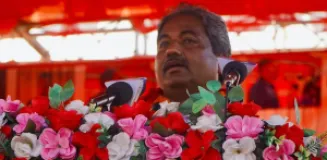
Infrastructure Development Minister Sunil Lamsal has pledged that there will be no shortage of budget for the reconstruction of the Kaligandaki Corridor, which has been badly damaged by monsoon-induced floods and landslides. Lamsal made the commitment after carrying out an on-site inspection of the damaged route, during which he travelled through Gulmi, Baglung, Parbat and Myagdi districts, reaching as far as the Rupshe Waterfall on the Mustang border. The purpose of the visit was to assess first-hand the extent of the destruction to critical infrastructure along the corridor and to review the condition of a road link that serves as a key transport artery for the hill districts it crosses. Speaking during the inspection, the minister assured that reconstruction projects on the corridor would move ahead without being held back by financial constraints.
Minister inspects damaged sections across four districts
The inspection covered a substantial stretch of the Kaligandaki Corridor, taking Minister Lamsal through four districts along the route. Beginning in Gulmi, he travelled through Baglung and Parbat before entering Myagdi, examining the damaged sections of the road as he went. The journey concluded at the Rupshe Waterfall on the border with Mustang, the farthest point of his inspection.
The minister's route and objectives can be summarised as follows:
- The inspection covered Gulmi, Baglung, Parbat and Myagdi districts along the corridor.
- Lamsal travelled along the damaged road up to the Rupshe Waterfall on the Mustang border.
- The visit focused on assessing damage caused by monsoon-induced floods and landslides.
- The minister pledged that reconstruction projects would face no budget constraints.
By travelling the route in person rather than relying on reports, Lamsal was able to observe directly the scale of the damage inflicted on critical infrastructure by the monsoon disasters. Such on-site inspections are typically used to inform decisions on how reconstruction work is planned and prioritised, and the minister's presence along the full stretch of the damaged road underlined the importance his office has attached to restoring the route.
No budget constraints, minister assures
The central message of the visit was the minister's assurance on funding. Lamsal pledged that there would be no budget constraints for the reconstruction projects along the corridor, a commitment aimed at removing one of the most common obstacles that delay the rebuilding of monsoon-damaged roads in Nepal's hill regions.
The assurance carries particular weight because reconstruction of strategic road infrastructure often stalls when funds fail to arrive on time, leaving damaged sections unusable for extended periods. By stating clearly that money would not be a barrier, the minister signalled that the damaged sections of the Kaligandaki Corridor are expected to be taken up for reconstruction as a priority.
Lamsal's pledge was delivered at the site of the damage itself, following his journey through the four districts. Coming at the end of an inspection that stretched all the way to the Rupshe Waterfall on the Mustang border, the statement was framed as a commitment tied to what he had seen on the ground, rather than a general promise made from a distance. The message was that the destruction he witnessed would be addressed, and that financial resources would be made available to ensure the rebuilding work is carried through.
A key route battered by monsoon disasters
The damage that prompted the visit was caused by monsoon-induced floods and landslides, hazards that regularly take a heavy toll on road infrastructure across Nepal's hill districts during the rainy season. The Kaligandaki Corridor traverses difficult terrain through Gulmi, Baglung, Parbat and Myagdi, and damage along such routes does not remain a transport problem alone.
When a corridor of this kind is disrupted, the effects ripple outward across the districts it serves:
- Movement of people between the districts becomes difficult and, at damaged points, may be halted entirely.
- The supply of daily essentials, including food, fuel and medicine, comes under pressure.
- Vehicles are forced onto long detours or off the road altogether, raising travel costs and times.
- Local trade and access to markets, schools and health facilities are disrupted.
These are the practical consequences that make the timely reconstruction of a damaged corridor a matter of urgency for the communities living along it. The minister's inspection route, running through all four affected districts up to the Mustang border, reflected the reality that the damage is not confined to a single point but stretches across a long and geographically challenging section of the road.
Focus shifts to rebuilding
With the inspection complete and the funding pledge made, attention now turns to the reconstruction of the damaged sections. The minister's assurance that budget will not be a constraint is expected to guide the next phase of work on the corridor, as the concerned authorities move from assessing the damage to repairing it.
The visit and the pledge together frame the reconstruction of the Kaligandaki Corridor as a funded and prioritised task rather than an uncertain one. For the districts of Gulmi, Baglung, Parbat and Myagdi, where the corridor functions as a principal road link, the restoration of the damaged sections will determine how quickly normal movement of people and goods returns. The minister's message during the inspection was that the resources needed to achieve that restoration will be in place, and that the damage surveyed along the route to the Rupshe Waterfall will be addressed through reconstruction projects that proceed without financial hindrance.