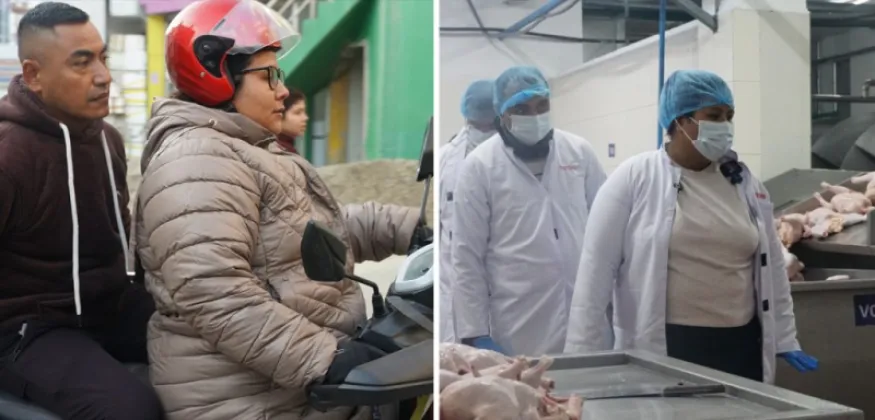
Minister for Agriculture, Forest and Environment Gita Chaudhary carried out surprise inspections of meat cold storage facilities in Balaju and Sitapaila of Kathmandu on November 26, examining storage conditions, sanitation standards, meat quality and overall food safety at the facilities. The unannounced visits were part of a broader effort to verify whether meat businesses in the capital are complying with the Animal Slaughterhouse and Meat Inspection Act, 2055, which came into force on November 17.
The inspections added a notably low-profile twist. According to OnlineKhabar, Minister Chaudhary rode a scooter herself, travelling from the minister's quarters in Jawalakhel, Lalitpur, to the Kathmandu facilities. The unmarked arrival meant that operators at the sites had no advance warning of the minister's visit, allowing her to observe conditions as they actually were rather than as they might have been prepared for an official delegation.
Focus on Food Safety and Compliance
During the inspections at both Balaju and Sitapaila, the minister assessed a range of factors central to consumer health: how meat was being stored, whether hygiene and sanitation were being maintained, the quality of the meat kept in the cold storages, and general food safety practices. These areas are precisely what the newly enforced Animal Slaughterhouse and Meat Inspection Act, 2055 is designed to regulate, covering the treatment of animals at slaughterhouses and the standards under which meat is inspected, handled and stored before reaching consumers.
The timing of the inspections is significant. The Act came into force only days earlier, on November 17, making the visits one of the first high-level compliance checks since the law became operative. By appearing in person and without prior notice, the minister signalled that enforcement of the legislation is being treated as an immediate priority rather than a gradual process.
Why Surprise Inspections Matter
Meat cold storages occupy a critical point in Nepal's food supply chain. Large volumes of meat sold in Kathmandu pass through storage and distribution facilities before reaching retail outlets, and lapses in refrigeration, cleanliness or quality control at this stage can have direct consequences for public health. Consumers in the capital have long been concerned about the safety of the meat they buy, and regulators have repeatedly faced questions about how effectively standards are monitored.
Unannounced inspections are widely regarded as one of the more effective tools for oversight precisely because they remove the opportunity for facilities to prepare. When operators know an inspection is coming, storage areas can be cleaned, substandard stock can be moved out of sight, and records can be arranged in advance. By arriving unannounced, Minister Chaudhary sought a picture of routine, day-to-day operations at the Balaju and Sitapaila facilities.
The Minister's Unconventional Arrival
The detail that has drawn particular public attention is how the minister got there. Chaudhary rode a scooter herself from the minister's quarters in Jawalakhel, Lalitpur, according to OnlineKhabar. Rather than travelling in an official convoy with security and support staff in tow, which would have announced her arrival well in advance, she made the journey across the valley on a two-wheeler.
The move reflects a practical approach to conducting an effective inspection. A minister arriving on a scooter is far less conspicuous than one arriving with a full official entourage, allowing the inspections to retain their element of surprise from start to finish. It also offered a visible gesture of accessibility, with a cabinet minister navigating the same roads as ordinary commuters to carry out her official duties.
New Law, Early Enforcement
The inspections underline the intent behind the Animal Slaughterhouse and Meat Inspection Act, 2055, which governs slaughterhouse operations and meat inspection standards in Nepal. The law had been on the books for decades before coming into force on November 17, and its activation places fresh obligations on slaughterhouses, cold storages and meat traders to meet statutory standards on animal handling, hygiene and meat quality.
By choosing cold storages in Balaju and Sitapaila as early targets of inspection, the ministry focused on facilities that sit at the heart of the meat supply chain serving Kathmandu. The checks covered the core questions the Act is meant to answer: whether meat being stored for sale is being kept under proper conditions, whether sanitation is up to standard, and whether the quality of the product reaching consumers can be assured.
What follows from Tuesday's inspections, including any findings, corrective directions or enforcement action taken against the facilities, has not been detailed in the available reports. Further announcements from the Ministry of Agriculture, Forest and Environment on the outcome of the visits and on additional inspections under the newly enforced Act are expected to clarify how rigorously the law will be applied in practice.
For now, the November 26 inspections stand as an early and visible demonstration of enforcement intent: a minister arriving by scooter, unannounced, to see for herself whether the meat stored in Kathmandu's cold storages meets the standards that Nepal's freshly operational meat inspection law requires.
For the original reporting, see OnlineKhabar and Khabarhub.