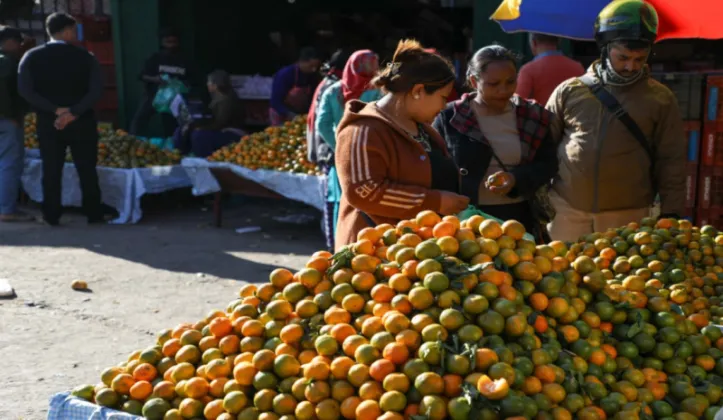
The main mandarin season has begun, and trading of the winter fruit has picked up at the Kalimati Fruits and Vegetable Market in Kathmandu. Mandarins brought in from various districts have started arriving at the market in larger quantities, marking the start of the busiest period of the year for the fruit.
Fresh supply reaches the capital
Mandarins arriving at the Kalimati market are being sourced from districts across the hills, including Gorkha, Tanahun, Syangja and Kaski. These districts are among the areas from where consignments of the fruit have begun reaching the capital as the season gets underway.
The arrival of fruit from these producing districts has brought visible activity back to the market, with traders handling mandarins as the headline item of the season. As the season progresses, the flow of mandarins from these and other growing areas is expected to continue into the market.
Prices set by size and quality
According to traders at the market, prices of mandarins are being set according to the size and quality of the fruit. This means that fruit of different grades is being sold at different rates, with larger and better-quality mandarins commanding higher prices than smaller or lower-grade fruit.
This pricing practice reflects how the seasonal fruit is graded before it reaches consumers. Buyers visiting the market can expect variation in prices depending on the batch, as traders assess each lot on the basis of how big the fruit is and its overall condition.
The start of the main season
The pick-up in trading follows the onset of the main mandarin season, the time of year when harvests from the mid-hill districts reach their peak and supply to urban markets like Kathmandu rises sharply. For the Kalimati Fruits and Vegetable Market, the country's central wholesale hub for fresh produce, the mandarin season is one of the busiest stretches of the trading calendar.
Traders at the market report that transactions have picked up now that the season is underway. The arrival of mandarins from Gorkha, Tanahun, Syangja and Kaski signals that orchards in these districts have begun harvesting and shipping their produce, linking hill farmers directly with consumers in the capital.
What lies ahead this season
With the season just beginning, the focus now turns to how supply and prices develop in the coming weeks. Traders say the current pricing is based on size and quality, and buyers will be watching whether rates hold steady as more fruit arrives from the growing districts.
For now, the market has seen the return of mandarin trading after the off-season lull, with fruit from Gorkha, Tanahun, Syangja and Kaski filling stalls at Kalimati. Consumers in Kathmandu can expect steady availability of the fruit as the main season moves into full swing, while farmers in the producing districts look to the market for the sale of their harvest.