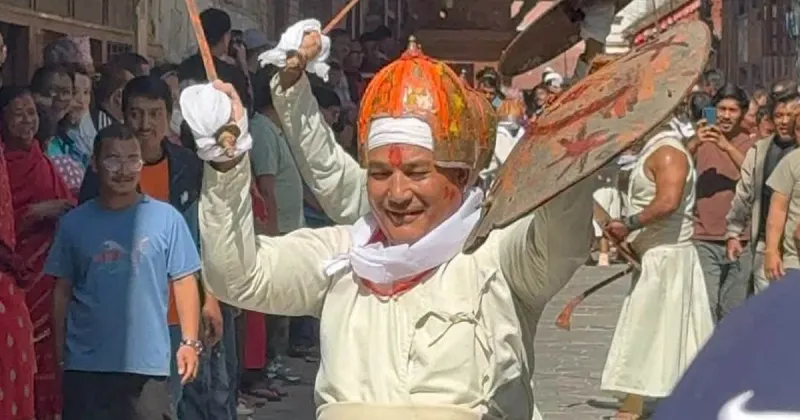
The Khā Pihāwaigu jatra, popularly known as the Thimi jatra, has been held in Thimi, with the festival once again reenacting a war from the Malla era before concluding successfully, according to a report by Thaha Khabar. Observed as both a cultural and religious festival, the event stands out among the many celebrations of the Kathmandu Valley for the way it brings martial history out of the pages of chronicles and into public view. As reported, the jatra is presented as a living reminder of the martial traditions of the Malla period, an era whose legacy remains deeply woven into the festival culture of the valley.
A war from the Malla era, retold in festival form
The defining feature of the Khā Pihāwaigu jatra is its reenactment of a battle from the Malla period. Rather than simply commemorating history through ritual alone, the jatra stages the conflict itself, allowing the community to witness a dramatised memory of warfare from centuries past. In doing so, the festival preserves a dimension of history that few other observances capture: the martial spirit of an age when the towns of the valley were governed by the Malla kings.
The Malla era occupies a central place in the history of the Kathmandu Valley. It was during the centuries of Malla rule, which ended only with the Shah conquest of the valley in the eighteenth century, that the valley's towns, including Thimi and neighbouring Bhaktapur, developed much of the art, architecture and festival culture for which they are celebrated today. Against that backdrop, a jatra that reenacts a Malla-era war is more than entertainment. It is a form of historical memory, performed in public and passed on to new generations in a way that written records alone cannot achieve.
The festival at a glance
- Name: Khā Pihāwaigu jatra, also known as the Thimi jatra
- Place: Thimi, a historic Newar town in the Kathmandu Valley
- Character: a cultural and religious festival
- Highlight: a reenactment of a war from the Malla era
- Outcome: the festival was held and concluded successfully
Where culture and religion come together
The Khā Pihāwaigu jatra is not only a historical pageant. The report describes it as a cultural and religious festival, a combination that is characteristic of Newar observances across the Kathmandu Valley. In this tradition, jatras are occasions on which ritual worship, community celebration and public performance merge into a single shared experience. Devotional purpose and festive celebration reinforce one another, and the town itself becomes the setting for the observance.
For Thimi, a settlement known for its deep-rooted Newar heritage and its rich calendar of traditional festivals, such observances are central to its identity. The Thimi jatra, under its local name Khā Pihāwaigu, is one of the celebrations through which the community expresses that identity, linking religious faith with the memory of the town's past. The reenactment of a Malla-era war within this setting gives the festival a distinctive character, setting it apart from observances that focus purely on ritual or on spectacle.
Such festivals also carry a social dimension. Jatras bring together residents across generations, drawing elders who carry the knowledge of tradition and younger participants who learn it through involvement. In towns like Thimi, where Newar customs have been practised for centuries, this passing down of tradition from one generation to the next is precisely what keeps a festival alive rather than allowing it to become a memory of the past.
A successful conclusion and a heritage kept alive
According to the report, the jatra concluded successfully, a detail that underscores the continuity of an observance that the community clearly values. The successful conclusion of such a festival matters beyond mere logistics. It signals that the knowledge, participation and enthusiasm required to stage a complex traditional event remain strong, and that the traditions embodied in the jatra are being handed on rather than fading away.
The description of the jatra as a living reminder of Malla-era martial traditions captures its broader significance. Monuments and chronicles can preserve the memory of a historical period, but festivals like the Khā Pihāwaigu jatra allow that memory to be experienced. Each holding of the festival reconnects the present-day community of Thimi with the martial heritage of the Malla period, ensuring that this chapter of history remains part of the town's living culture rather than a distant and abstract past.
In a rapidly changing Kathmandu Valley, where urban growth and modern lifestyles press against traditional practice, the continued observance of festivals of this kind carries particular weight. The Khā Pihāwaigu jatra stands as evidence that Thimi's cultural heritage is not confined to museums or archives but is rehearsed, performed and celebrated in the town itself, year after year, by the community that inherited it.
Further details about the festival are available in the original report by Thaha Khabar.