Earthquake Jolts Taplejung-Sikkim Border Area
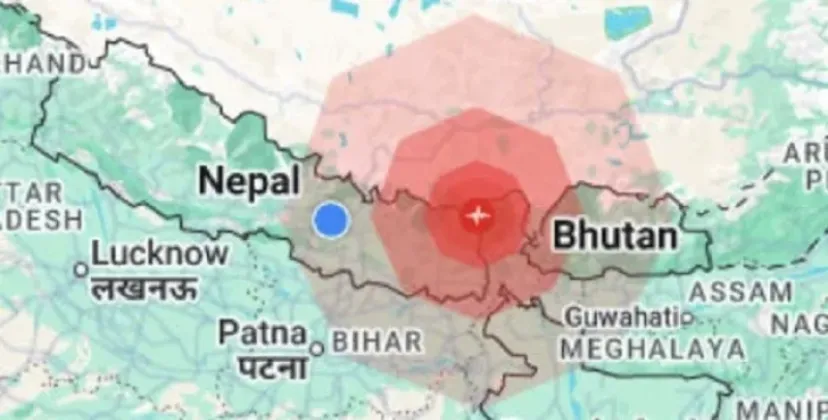
An earthquake measuring between 5.3 and 5.6 on the Richter scale struck near Taplejung in eastern Nepal on Tuesday morning at 7:17 am, sending tremors across much of the country. The quake, whose epicentre lay along the Nepal-Sikkim border area, was strong enough to be felt as far away as Kathmandu, prompting concern among residents in the capital and throughout the eastern hills.
Nepal's National Earthquake Monitoring and Research Centre measured the earthquake at a magnitude of 5.6, while the European-Mediterranean Seismological Centre (EMSC) put the figure slightly lower at 5.3. The EMSC located the epicentre approximately 68 kilometres northwest of Galsing in India's Sikkim state and about 94 kilometres north-northwest of Darjeeling, placing it in the mountainous border region between Nepal and India.
Discrepancy in Magnitude Readings
The difference in reported magnitudes between the two monitoring agencies is not unusual, as seismological institutions often use different methods and reference points when calculating the strength of an earthquake, particularly one that strikes in a remote mountainous area. Nepal's National Earthquake Monitoring and Research Centre, which is the country's authoritative body for seismic monitoring, recorded the event at 5.6 magnitude with the epicentre near Taplejung.
The EMSC, which monitors seismic activity across a wider region from Europe, calculated the magnitude at 5.3 and provided coordinates placing the tremor closer to the Indian side of the border. Despite the slight variance in numbers, both agencies confirmed that a moderate earthquake had occurred in the same general area at the same time, and the tremors were clearly felt on both sides of the Nepal-India border.
Tremors Felt Nationwide and Early Warning Issued
According to reports, the tremors were felt across the country, including in the Kathmandu Valley, where residents reported feeling their buildings shake. In eastern Nepal, closer to the epicentre, the shaking was reportedly stronger, though no immediate reports of damage or casualties were available in the hours following the event.
Notably, the Android Earthquake Alert system issued an early warning to users' devices ahead of or during the shaking, a feature that has increasingly become a first line of alert for people in seismically active countries like Nepal. The system, which is built into Android phones, uses the built-in accelerometers of millions of devices to detect shaking and push out alerts to nearby users seconds before strong tremors arrive.
Seismic Context and Response
Nepal lies in one of the most seismically active zones in the world, situated along the collision zone where the Indian tectonic plate pushes beneath the Eurasian plate. The eastern Nepal region near Taplejung, which borders Sikkim, has a history of seismic activity and lies within the broader Himalayan belt that produced devastating earthquakes in the past, including the 2015 Gorkha earthquake that killed thousands of people across central Nepal.
While earthquakes of magnitude 5.0 to 5.9 are classified as moderate and typically cause little damage in areas with well-built structures, they can still cause panic and, in regions with fragile, traditional stone-and-mud houses common in Nepal's hilly districts, occasionally lead to localized damage. Tuesday morning's quake came at a time when residents were beginning their day, with many people at home, raising fears about the potential impact on residential structures near the epicentre.
No details about casualties or property damage were reported in the immediate aftermath of the earthquake, and authorities have not yet issued any official statements regarding the situation in the affected areas of Taplejung. As is standard practice following significant seismic events, residents in the affected regions have been advised to remain alert for aftershocks, which frequently follow moderate earthquakes in the Himalayan region.
Further updates are expected as local authorities in Taplejung and the surrounding districts assess the situation and as Nepal's monitoring agencies continue to track any aftershock activity in the border region.