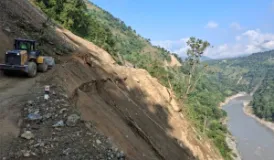
Finance Minister Swarnim Wagle has said the government will arrange the resources needed for rescue, relief, recovery and reconstruction following the disaster in the Bhote Koshi-Trishuli area, with post-disaster reconstruction alone estimated to require between 4 and 5 billion US dollars. Wagle made the remarks while addressing a meeting of the parliamentary special committee on climate change impacts in the Himalayas, climate justice and the Bhote Koshi-Trishuli disaster. His statement, reported by Nepal Samaya, Pradeshkhabar and Nepal Views, underscores the financial scale the government attaches to the response and frames the rebuilding effort as a long-term national undertaking.
A reconstruction bill measured in billions
The headline figure to emerge from the committee meeting is the cost estimate: 4 to 5 billion US dollars for post-disaster reconstruction. That range converts into hundreds of billions of Nepali rupees, and it covers only the reconstruction phase of the disaster response. The immediate costs of rescue operations and emergency relief, along with the intermediate costs of recovery, will come on top of the rebuilding estimate.
Wagle presented the government's obligation as a continuum of four connected phases:
- Rescue: the immediate emergency operation in the affected Bhote Koshi-Trishuli area.
- Relief: emergency assistance for the communities hit by the disaster.
- Recovery: the restoration of services and normal life in the aftermath.
- Reconstruction: the long-term rebuilding of what was damaged or destroyed, estimated at 4 to 5 billion US dollars.
By naming all four phases in a single commitment, the finance minister signalled that the government sees its responsibility as extending well beyond the emergency stage. The pledge to arrange the necessary resources applies to each of them, from the first days of rescue to the final stages of reconstruction.
Parliamentary oversight of the response
The forum in which the pledge was made is as significant as the pledge itself. Wagle delivered his remarks to the parliamentary special committee on climate change impacts in the Himalayas, climate justice and the Bhote Koshi-Trishuli disaster, a body whose mandate explicitly ties the disaster to two broader questions: the impact of climate change on the Himalayas and the principle of climate justice.
That framing matters. By constituting a special committee that links the Bhote Koshi-Trishuli disaster with Himalayan climate impacts and climate justice, parliament has signalled that it views the event within a wider pattern of climate-driven risk in the mountain region. The finance minister's appearance before the committee placed the government's disaster financing plans under parliamentary scrutiny and connected the question of paying for reconstruction to the broader debate over climate justice.
Resources promised for every phase
For the government, the commitment made before the committee is comprehensive even if the financing details are not yet settled: the state has pledged to see affected communities through rescue, relief and recovery, and then to rebuild on a scale measured in billions of dollars. The assurance that resources will be arranged applies across all four phases of the response, not only to the immediate emergency.
From pledge to funding
Wagle's statement is, at this stage, a commitment of intent. The reports of the committee meeting did not spell out how the government intends to mobilize the estimated 4 to 5 billion US dollars for reconstruction, nor over what period the spending would be spread. What the remarks do establish is the government's starting position: money will be found for every phase of the response, and the 4 to 5 billion dollar range now stands as the reference figure for planning the reconstruction.
A sum of that size represents a major undertaking for the national exchequer and will require sustained effort across budget cycles. The sequencing that Wagle outlined, moving from rescue and relief into recovery and then reconstruction, reflects the reality that the most expensive part of the response lies ahead, after the immediate emergency needs have been met.
The estimate also gives concrete weight to the committee's broader agenda. Discussions about climate change impacts in the Himalayas and climate justice acquire urgency when attached to a specific price tag: the cost of rebuilding after a disaster in the Bhote Koshi-Trishuli area. The minister's figures give lawmakers a tangible benchmark as they examine both the disaster response and the wider question of how a Himalayan country prepares for, and recovers from, events of this kind.
For now, the commitments made before the committee mark the beginning of the process rather than its conclusion. The government has stated its intention to fund rescue, relief, recovery and reconstruction in the Bhote Koshi-Trishuli area, and has put a preliminary price on the largest of those phases. How quickly that price becomes budgetary allocations, and how the burden of the bill is shared, will determine whether the finance minister's assurance translates into rebuilt infrastructure and restored livelihoods along the Bhote Koshi and Trishuli.