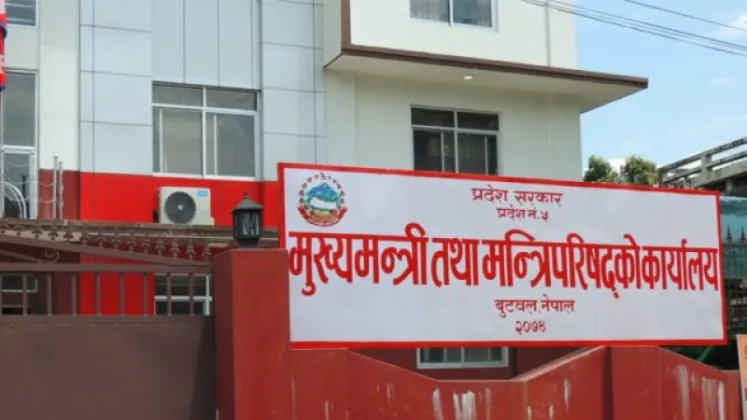
The Lumbini Province government has launched a child marriage reduction program covering every local level of the province, in what it has framed as a decisive push to make Lumbini free of child marriage. The campaign, announced from Dang, will reach students, out-of-school adolescent girls, parents and teachers through awareness activities, counselling and community-based prevention programs. The launch was accompanied by the issuance of the Child Marriage Reduction guidelines, which are intended to ensure the effective implementation of conditional grants the province has allocated to local governments for the fiscal year 2083/84.
A campaign built for every local level
Rather than beginning with a handful of pilot areas, the provincial government has designed the program to operate across all local levels of Lumbini Province, one of Nepal's seven provinces. The initiative was publicly announced from Dang, signalling that the campaign is intended as a province-wide undertaking rather than a limited, district-specific project.
As reported by Khabarhub, Onlinekhabar and Ratopati, the provincial government has presented the program as a coordinated campaign with a single, clearly stated objective: ending the practice of child marriage within the province.
The choice to route the program through all local levels reflects the structure of governance in Nepal, where local governments sit closest to communities and are responsible for delivering many of the social services on which families and adolescents depend. By extending the campaign to every local unit, the provincial government is seeking to ensure that no part of Lumbini is left outside the reach of the program.
Three approaches at the heart of the program
The campaign is not built around a single intervention. According to the announcement, it will combine three broad methods of prevention:
- Awareness programs, designed to inform communities about the consequences of child marriage and the importance of allowing adolescents, particularly girls, to continue their education and delay marriage.
- Counselling, offered to the groups the campaign identifies as its target audience, providing direct support to adolescents and the adults around them.
- Community-based prevention programs, which bring the message into the settings where decisions about early marriage are often made, engaging families, schools and neighbourhoods directly.
Taken together, these three strands are intended to work as a preventive framework, intervening before marriages take place rather than responding after the fact.
Guidelines tied to conditional grants
A central feature of the launch is the link between the campaign and the province's budget process. To ensure the effective implementation of the conditional grants allocated to local governments for the fiscal year 2083/84, the provincial government has issued the Child Marriage Reduction guidelines. These guidelines are meant to set out how the funds flowing to local levels are to be used in pursuit of the campaign's goals.
Conditional grants are one of the principal instruments through which provincial governments in Nepal channel resources to local governments for specified purposes. By attaching dedicated guidelines to these grants, the Lumbini Provincial Government is seeking to make sure that the money allocated for child marriage reduction is spent on the activities the campaign envisions, and that local levels have a common framework to follow as they implement the program in their own communities.
The issuance of formal guidelines also gives the campaign an administrative backbone. Local governments will be able to plan their activities, direct their spending and report on their progress against a single provincial document, rather than improvising approaches of their own.
Reaching students, girls, parents and teachers
The campaign identifies four distinct groups as its targets, and each plays a different role in the problem the province is trying to solve:
- Students, who can be reached through awareness and counselling activities while they remain in education.
- Out-of-school adolescent girls, who are often the hardest group to reach and for whom the risk of early marriage is frequently the greatest.
- Parents, whose decisions within the family are often central to whether an adolescent marriage goes ahead.
- Teachers, who are positioned to identify girls at risk and reinforce the value of staying in school.
By addressing adolescents and the adults who influence them in the same campaign, the program treats child marriage as a community-wide issue rather than a problem belonging to girls alone.
The goal: a child-marriage-free Lumbini
The provincial government has framed the program as a step toward an ambitious endpoint: a Lumbini Province free of child marriage. The campaign's design, from its province-wide coverage to its combination of awareness, counselling and community-level prevention, is aimed at building sustained pressure against the practice across every local level.
Much will now depend on implementation. The effectiveness of the program will hinge on how consistently local governments apply the new guidelines, how well the conditional grants for the fiscal year 2083/84 are translated into on-the-ground activities, and whether the targeted groups of students, out-of-school girls, parents and teachers are reached in practice. For now, the launch from Dang marks a formal, province-wide commitment by the Lumbini Provincial Government to confronting child marriage directly and through every available channel of local governance.