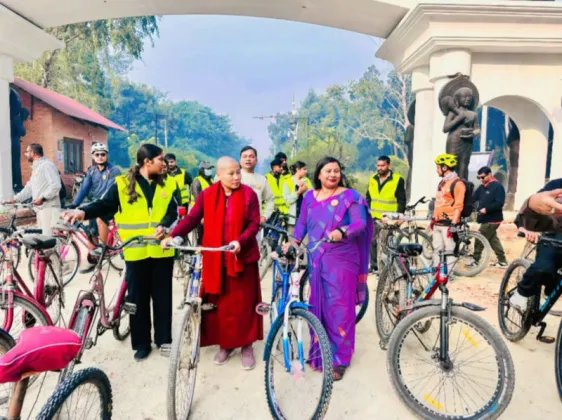
A new tourism initiative has been launched in Lumbini, the birthplace of Lord Buddha, with the aim of taking visitors beyond the sacred sites and into the surrounding villages, culture and natural landscapes. The 'Lumbini Cycle Tour' was formally launched on Tuesday under a sustainable tourism project that seeks to link the area's well-established religious tourism with nature, culture and everyday local village life.
The initiative, according to its organisers, is designed to ensure that the flow of tourists visiting Lumbini translates into tangible benefits for the communities living around the pilgrimage zone. By encouraging visitors to explore the wider region on bicycles, the project hopes to spread tourism's economic gains to rural households that have so far remained on the margins of the area's tourism economy.
Tourism beyond the pilgrimage circuit
Lumbini has long been known primarily as a religious destination, drawing pilgrims and visitors from Nepal and abroad to the Maya Devi Temple and the surrounding monastic zone. The newly launched cycle tour represents an attempt to broaden that experience. Organisers say cyclists taking part in the tour will be able to study villages, culture and nature along the route, turning a simple ride into an educational and immersive journey through the landscapes that surround the holy site.
The emphasis on cycling also reflects the broader goals of the sustainable tourism project under which the tour was launched. Rather than building new infrastructure or promoting high-volume tourism, the initiative relies on low-impact travel that allows visitors to move slowly through the countryside, interact with local residents and observe rural life at close quarters.
Linking tourism to local prosperity
A central ambition of the Lumbini Cycle Tour is to connect tourism in Lumbini with the economic prosperity of local communities. Organisers envision that as cyclists travel through villages along the route, spending on food, accommodation, guides and local products will flow directly into village economies, creating income opportunities for residents who have not traditionally benefited from the area's pilgrimage-driven tourism.
This approach aligns with widely accepted principles of sustainable and community-based tourism, which seek to distribute tourism revenue more evenly, reduce pressure on a single set of attractions, and give travellers a deeper and more authentic experience of a destination. In Lumbini's case, the surrounding villages, farmland and natural areas offer a contrast to the formal pilgrimage zone, and the cycle tour is intended to make these assets accessible in a structured way.
A new dimension for Lumbini tourism
The launch of the cycle tour adds a fresh dimension to Lumbini's tourism offer at a time when destinations across Nepal are looking to diversify beyond traditional sightseeing. For visitors, the tour promises a combination of physical activity, cultural learning and natural beauty, all within easy reach of one of the world's most significant Buddhist heritage sites.
For the local tourism sector, the initiative signals a shift in how the region's assets are being presented. Instead of positioning Lumbini solely as a place to visit for religious purposes, the project frames it as the centre of a wider network of villages, cultural traditions and natural attractions that can be explored at a relaxed pace on two wheels.
What organisers hope to achieve
According to organisers, the tour is expected to serve multiple purposes at once. Cyclists will gain the opportunity to study village life, culture and nature along the route, while local communities stand to gain from increased visitor engagement and spending. By tying the experience directly to the sustainable tourism project, the organisers also hope to set a model for how tourism growth in Lumbini can be pursued in a way that is environmentally responsible and socially inclusive.
The launch on Tuesday marks the formal beginning of the initiative, and attention will now turn to how the tour develops in practice, how widely it is adopted by visitors, and how effectively its economic benefits reach the villages it is designed to support. For now, the Lumbini Cycle Tour stands as a concrete step toward a vision of tourism in the region that goes beyond the temples, connecting the birthplace of the Buddha with the people, traditions and landscapes that surround it.