The Living Goddess Kumari was taken to the historic Taleju Bhawani Temple at Hanumandhoka in Kathmandu on Tuesday night for a traditional ritual that forms part of the valley's long-standing religious calendar. The child goddess was escorted from her official residence at Kumari Ghar in a ceremonial chariot procession, and the worship at the temple was carried out in accordance with both Tantric and Vedic traditions. Gautam Shakya, the Manager of Kumari Ghar, confirmed that the Kumari was brought to the Taleju Temple complex under established protocol, in an observance that once again underlined the deep bond between the Living Goddess and the shrine regarded as her mythic origin.
A Ceremonial Procession Through the Old City
The visit began at Kumari Ghar, the traditional residence of the Royal Kumari of Kathmandu, situated near Basantapur Durbar Square at the heart of the old city. From there, the Living Goddess was placed in a ceremonial chariot and escorted to the Taleju Temple complex within the Hanumandhoka grounds. Such movements of the Kumari outside her residence are rare and are conducted with careful adherence to custom, reflecting the reverence in which she is held across the Kathmandu Valley.
Shakya said the arrangements followed the traditional pattern observed for such occasions, with the Kumari taken to the temple at night especially for the ritual. Key points of the event include:
- The Kumari was taken to the Taleju Bhawani Temple at Hanumandhoka on Tuesday night.
- She was escorted from Kumari Ghar in a ceremonial chariot procession.
- The worship at the temple was performed according to Tantric and Vedic traditions.
- Gautam Shakya, Manager of Kumari Ghar, confirmed the arrangements for the visit.
Worship in the Tantric and Vedic Traditions
According to My Republica, the ritual was performed in line with both Tantric and Vedic traditions. This dual character of worship is a hallmark of religious life in the Kathmandu Valley, where esoteric tantric rites and Vedic ceremonies have coexisted for centuries within the same temples, festivals and royal institutions.
Night-time worship of this kind is among the most closely guarded of the valley's ritual practices, and the participation of the Living Goddess gives it particular significance. For the devotees and priests involved, the occasion is not a public spectacle but a solemn act of devotion carried out much as it has been for generations, preserving forms of ritual that have survived wars, dynastic change and the transformation of Nepal from a kingdom to a republic.
The Goddess and Her Temple
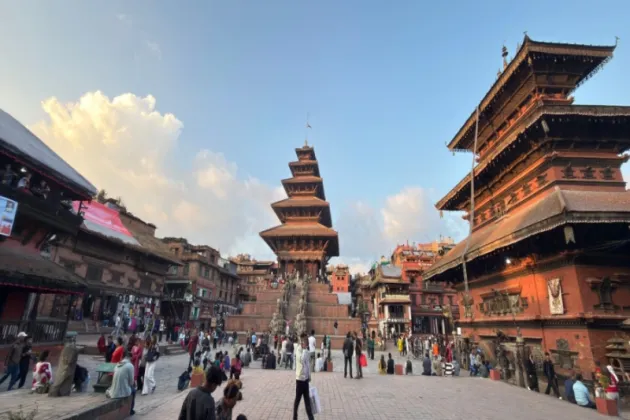
The Taleju Bhawani Temple stands within the Hanumandhoka Durbar complex, the historic seat of Nepal's former royalty in the centre of Kathmandu. Taleju Bhawani has long been revered as the protective deity of the valley's erstwhile royal line, and the temple remains one of the most sacred sites in the capital. It is ordinarily closed to the general public, and entry is reserved for special occasions and worship.
The Living Goddess Kumari is herself venerated as the human embodiment of the same divine force, which is why her presence at the temple for special worship carries such weight. The ritual performed on Tuesday night is understood within this framework: the goddess, in her living form, being brought to the temple of her own tutelary deity in an act of devotion that binds together temple, residence and tradition.
The Living Goddess of Kathmandu
The Kumari is a young girl, selected from the Newar community, who is worshipped as a living goddess while she remains pre-pubescent. She resides at Kumari Ghar and receives devotees throughout the year, as many believe that a glimpse of the Living Goddess brings good fortune. She also makes public appearances during major festivals, most notably when her chariot is drawn through the old city during Indra Jatra, one of the valley's most important celebrations.
The institution of the Kumari has endured through the Malla era, the Shah and Rana periods and into modern republican Nepal, adapting to changing times while retaining its core rituals. The management of Kumari Ghar oversees the daily life, care and ceremonial obligations of the Living Goddess, ensuring that practices handed down over centuries continue without interruption.
A Living Heritage Endures
Tuesday night's ritual at Taleju Bhawani Temple served as a reaffirmation of the Kathmandu Valley's extraordinary living heritage. In a rapidly modernising capital, the sight of the Living Goddess travelling by ceremonial chariot from Kumari Ghar to the temple of Taleju Bhawani is a reminder that the valley's religious and cultural practices are not relics of the past but active, observed traditions.
For the residents of Kathmandu, and for the devotees who follow the Kumari's public appearances, such occasions strengthen the continuity between generations. As the Manager of Kumari Ghar confirmed, the Living Goddess was brought to the temple complex and the worship completed as prescribed, adding another chapter to a tradition that has been preserved in the heart of Nepal's capital for centuries.